Archive for the ‘Wanderings’ category

Flag of Heroes in Grand Central

March 9, 2008

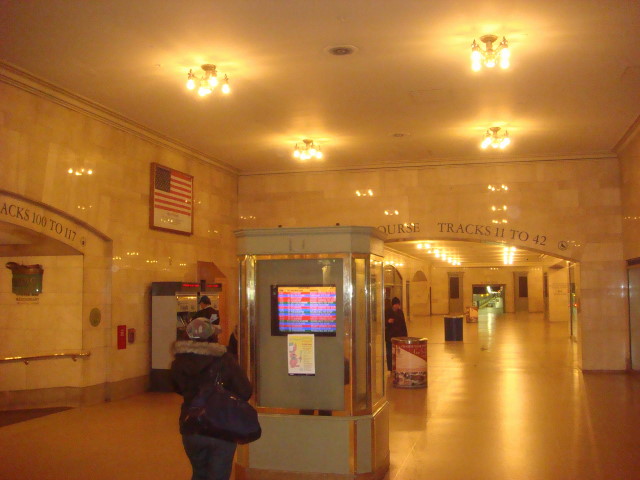
I was recently in Grand Central and noticed something that I hadn’t seen before.

20080301-flag-of-heroes-02.jpg

If you look to the right side of the above, you’ll see an American flag in a frame.  When I saw it, I wondered what it was about.  Having framed pictures on the wall isn’t really one of those things you see.

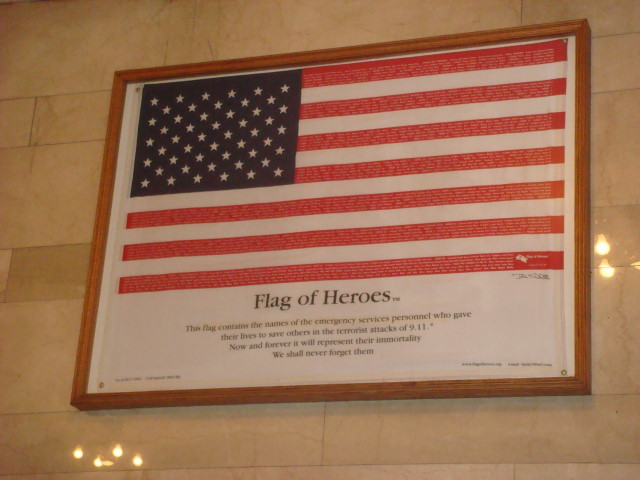
I took a closeup of it and saw that it really isn’t a “real” flag, but rather an artistic representation called “Flag of Heroes”.  The “flag contains the names of the emergency services personnel who gate their lives to save others in the terrorist attacks of 9/11.”

You can see their names in small print on the red stripes.

20080301-flag-of-heroes-01.jpg

It turns out that this is a commercially available flag.  That just strikes me as unusual for the City to have in a public space.  However, the proceeds seem to be strickly earmarked to charitable projects.

-H

McSorley’s Old Ale House

March 8, 2008

My recent jaunt in the Village was with the mind to find a legendary place.  Okay, it wasn’t all that legendary to me.  Some co-workers had mentioned it as the place to go for the St. Patricks Day Paraders and I hadn’t heard of it (at least to my recollection).

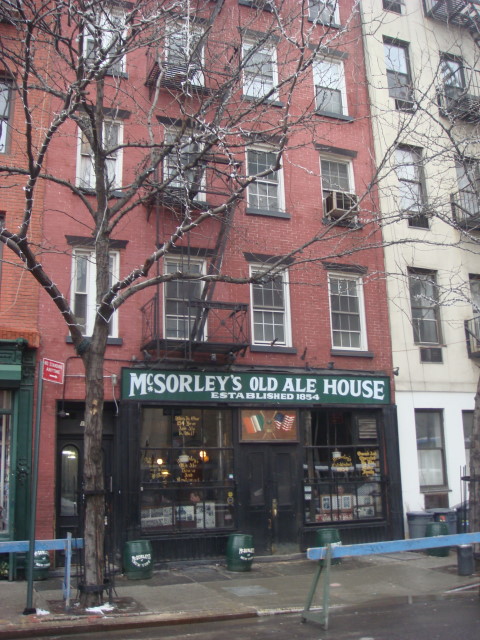
It’s McSorley’s Old Ale House, a bar located on East 7th Street near 3rd Avenue.  It has the slogan “We were here before you were born”.  True enough, it was founded in 1854.

20080223-mcsorleys-01.jpg

It strives to maintain its history, including sawdust covered floors and bragging rights that its patrons range from Abe Lincoln to John Lennon.

As it is strictly a bar and I am not a lover of beer, I didn’t bother going in.  It looks interesting for others, though.

-H

Sniffen Court

March 7, 2008

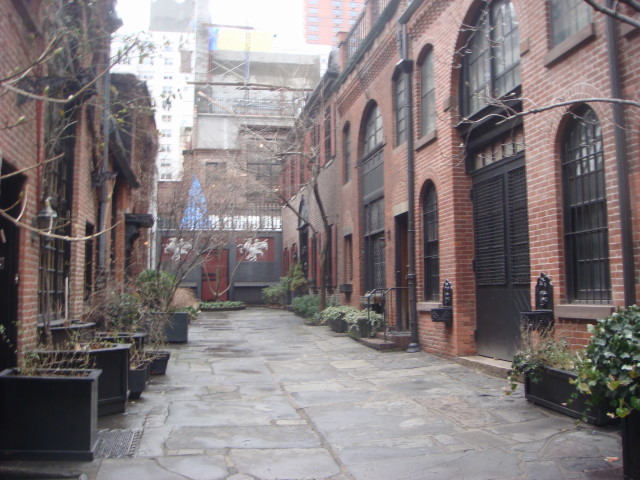
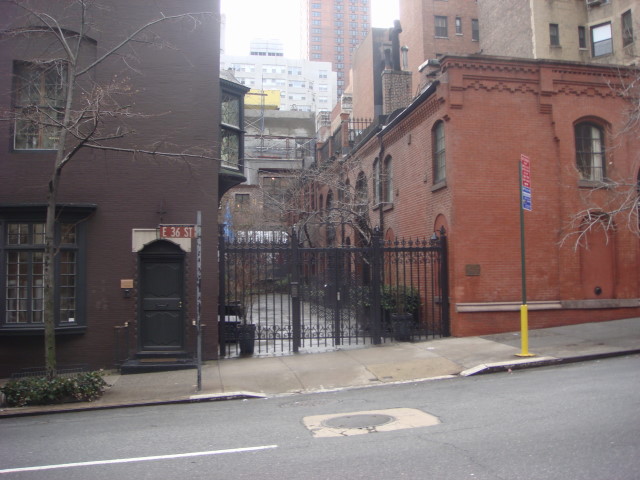
Just off 36th Street, between 3rd Avenue and Lexington, is Sniffen Court.  There’s not much to it.  Sort of a really, really nice alley.

20080222-sniffen-court-01.jpg

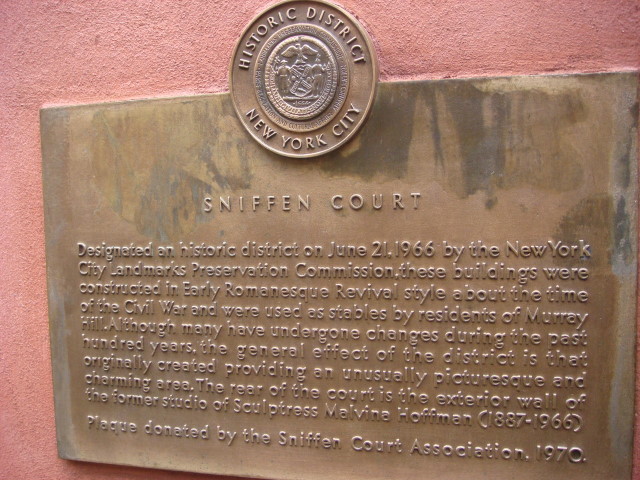
There’s a nice plaque noting the history (as you probably know, I love to look and read plaques).

20080222-sniffen-court-02-plaque.jpg

I always like to spell out the plaques, too.  It reads:  “Sniffen Court – Designated an historic district on June 21, 1966 by the New York City Landmarks Preservation Commission, these buildings were constructed in Early Romanesque Revival style about the time of the Civil War and were used as stables by residents of Murray Hill.  Although many have undergone changes during the past hundred years, the general effect of the district is that originally created providing an unusually pictureesque and charming area.  The real of the court is the exterior wall of the former studio of Sculptress Malvina Hoffman (1887-1966). – Plaque donated by the Sniffen Court Association 1970.”

But the real story of Sniffen Court?  It’s a very private and you need a key to get into it.  A nice and secure place.

20080222-sniffen-court-04.jpg

I am sooooo envious.

-H

Lever House and “The Virgin Mother” Sculpture

March 6, 2008

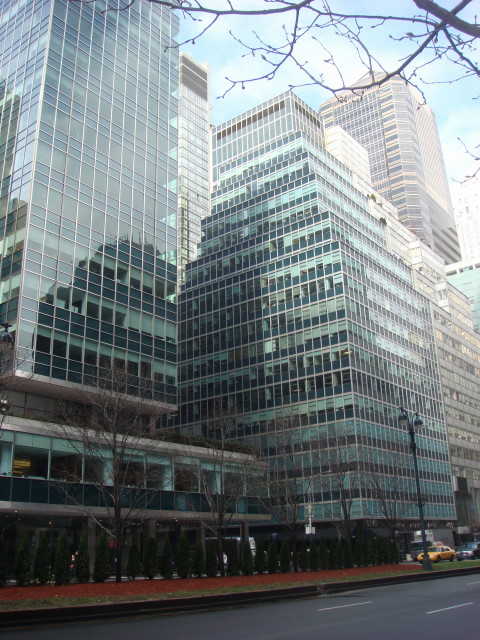
Lever House is one of NYC’s historic skyscraper buildings.  It was built in 1952 by the Lever brothers, of soap-making fame.  It’s called the first of the “International Style” of buildings.

20080222-lever-house-01.jpg

It’s green color makes it distinctive, along with the uniformity of its window shades.

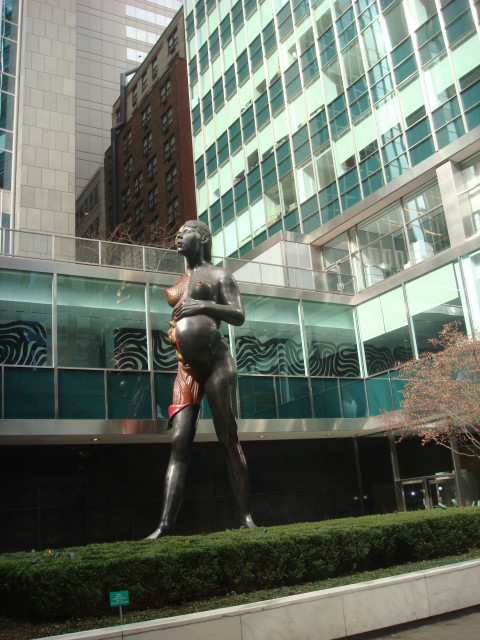
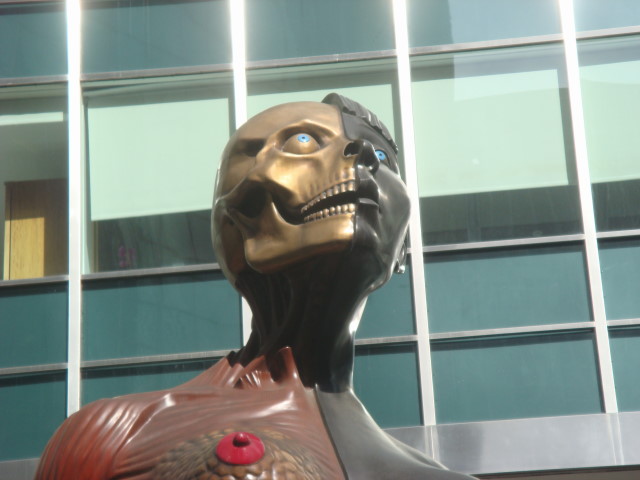
There’s an art space in an open area within the grounds.  At present, there’s a weird statue called “The Virgin Mother” by Damien Hirst.  I guess he has all sorts of “art” reasons why it is great, but I must confess that I found it..unmoving.

20080222-lever-house-02.jpg

Yep, it’s a nude woman; but more than just nude.  The artist want’s to show us what’s underneath, so he has it with cut-away flesh to show the baby within and the muscle below.

dsc06699.jpg

And strips away the face, at least in part.

20080222-lever-house-04.jpg

My guess is that the artist is trying to be provocative by citing the virgin Mary and having her nude and beyond.  And it is…well, the only thing I’ll say is to quote from a song from the movie “Popeye” where Olive Oyl is trying to say something good about Brutus and simply comes up with “and he’s large”.  Yes, it’s a large sculpture.  Mr. Hirst can be proud of that.  Yep, it’s large.

 Although I’m not fond of a lot of art, my distaste towards this arises from the abomination around town called the Bodies Exhibit that I can’t stand.  Oh, and if you thought you were to think the sculpture is “educational” in any way, note that the flap of skin on the thigh.  That shows that this is supposed to be more an evisceration than an X-ray view beneath the skin.

-H

Ankling to Cooper Union

March 5, 2008

You know, I always thought it was “Coopers Union” and not “Cooper Union”.  But three plaques say it is “Cooper Union”.  Not a huge wording difference, but I guess it could mean the difference between a guild of barrel makers and a place founded by somebody by the name of “Cooper”.

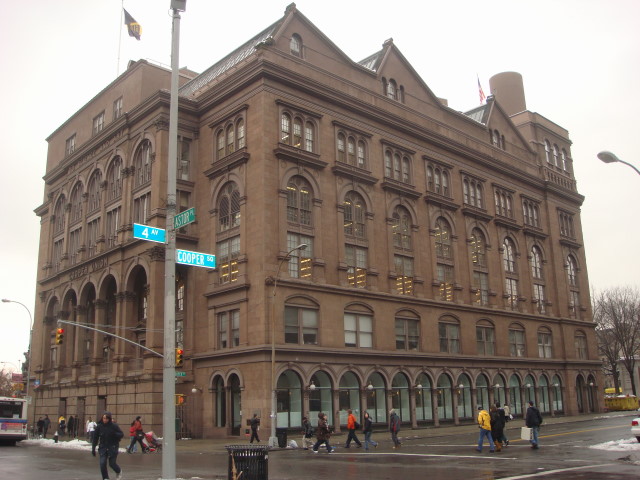
And what is Cooper Union?  Well, here it is below, located at the corner of 4th Avenue, Cooper Square, and Astor Place.  Yeah, three adjoining streets; including the mysterious “4th Avenue” which disappears north of 14th Street.
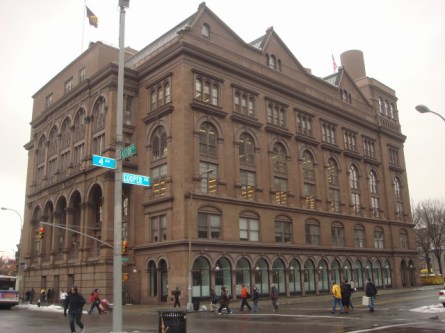
20080223-cooper-union-06.jpg

But that’s just a building.  Cooper Union is actually the second of my above possibilities: “Cooper Union for the Advancement of Science and Art“, a very selective and august university.  It was founded in 1859 by Peter Cooper and is known for giving full scholarships to its students.  Cooper was an industrialist and inventor.  He designed the first American steam locomotive, the Tom Thumb; and, according to Wikipedia, has a certain claim on the invention of Jell-O.  Now, that’s a diverse set of achievements.

But the building itself is also an achievement.

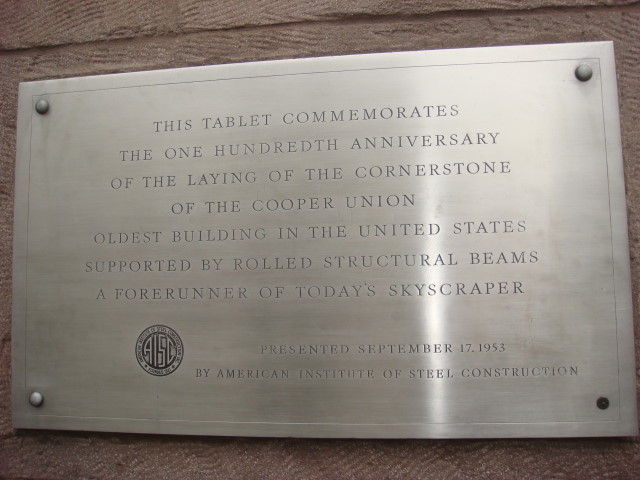
20080223-cooper-union-01-plaque-1.jpg

According to the plaque above, the Union building is the oldest building in the United States supported by rolled structural beams, a forerunner of today’s skyscrapers.

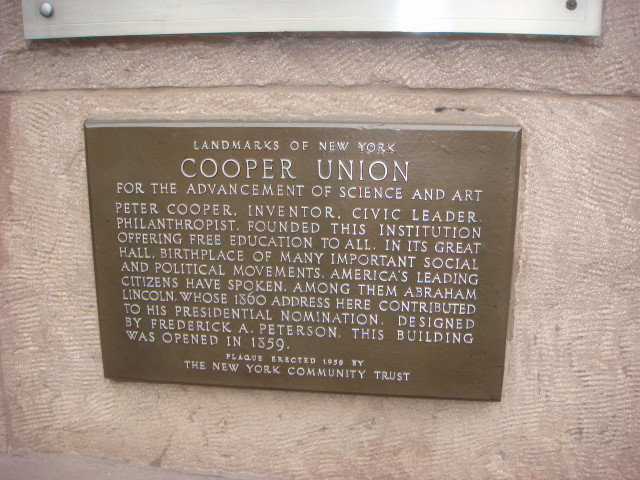
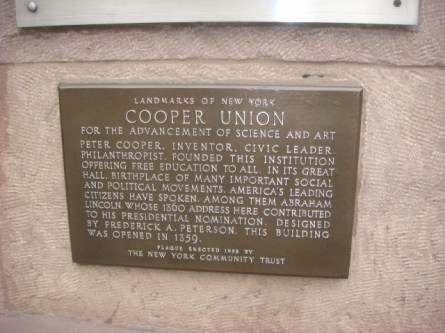
The next plaque is for both the school and the building.  It states “Cooper Union for the Advancement of Science and Art – Peter Cooper, inventor, civic leader, philanthropist, founded this institution offering free education to all.  In its great hall, birthplace of many important social and political movements, American’s leading citizens have spoken.   Among them Abraham Lincoln, whose 1860 address here contributed to his presidential nomination.   Designed by Frederick A. Peterson, this building was opened in 1859.”
20080223-cooper-union-02-plaque-2.jpg

Right next to the Union is a square named, appropiately, Cooper Square.
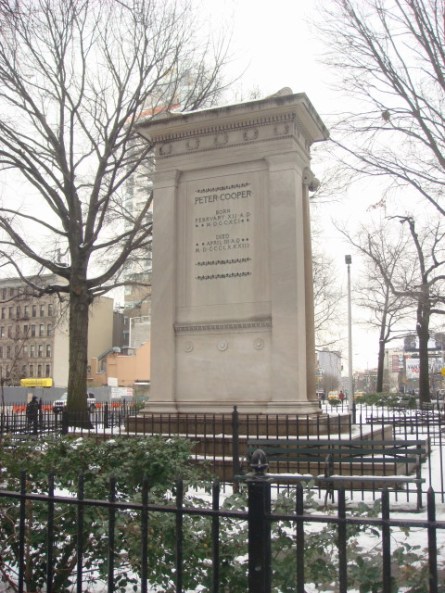
20080223-cooper-union-07-park.jpg

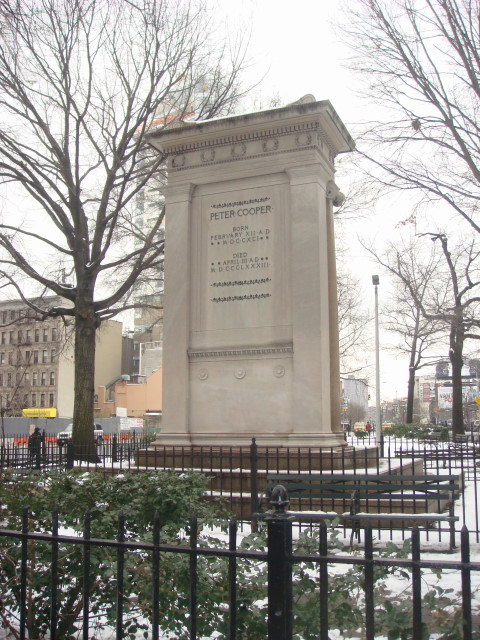
The monument in the middle gives Cooper’s name and birth/death dates (February 12, 1791 and April 3, 1883, respectively).

-H