Archive for March 2008

Sniffen Court

March 7, 2008

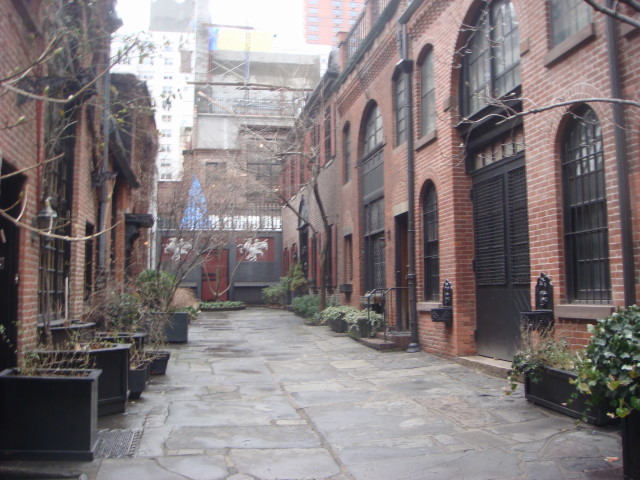
Just off 36th Street, between 3rd Avenue and Lexington, is Sniffen Court.  There’s not much to it.  Sort of a really, really nice alley.

20080222-sniffen-court-01.jpg

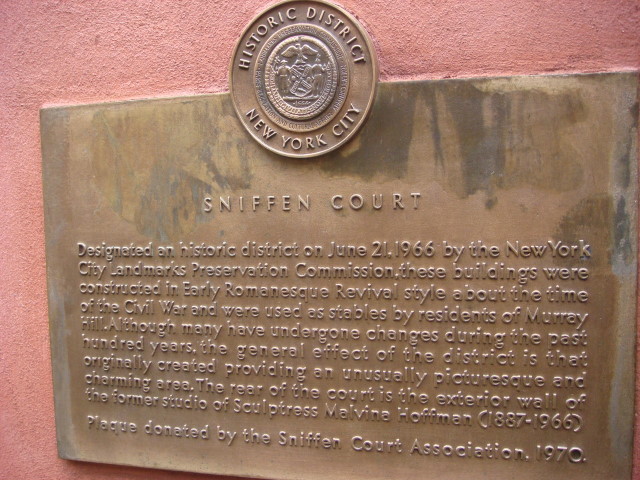
There’s a nice plaque noting the history (as you probably know, I love to look and read plaques).

20080222-sniffen-court-02-plaque.jpg

I always like to spell out the plaques, too.  It reads:  “Sniffen Court – Designated an historic district on June 21, 1966 by the New York City Landmarks Preservation Commission, these buildings were constructed in Early Romanesque Revival style about the time of the Civil War and were used as stables by residents of Murray Hill.  Although many have undergone changes during the past hundred years, the general effect of the district is that originally created providing an unusually pictureesque and charming area.  The real of the court is the exterior wall of the former studio of Sculptress Malvina Hoffman (1887-1966). – Plaque donated by the Sniffen Court Association 1970.”

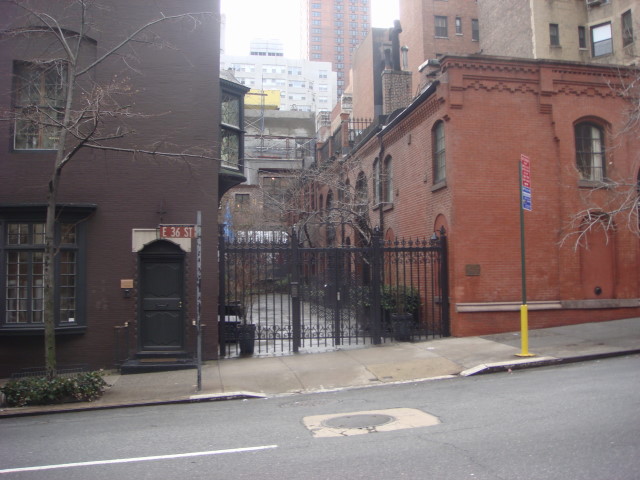
But the real story of Sniffen Court?  It’s a very private and you need a key to get into it.  A nice and secure place.

20080222-sniffen-court-04.jpg

I am sooooo envious.

-H

Lever House and “The Virgin Mother” Sculpture

March 6, 2008

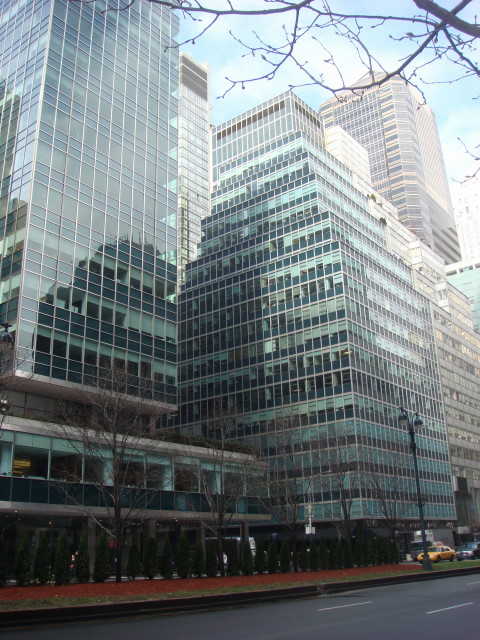
Lever House is one of NYC’s historic skyscraper buildings.  It was built in 1952 by the Lever brothers, of soap-making fame.  It’s called the first of the “International Style” of buildings.

20080222-lever-house-01.jpg

It’s green color makes it distinctive, along with the uniformity of its window shades.

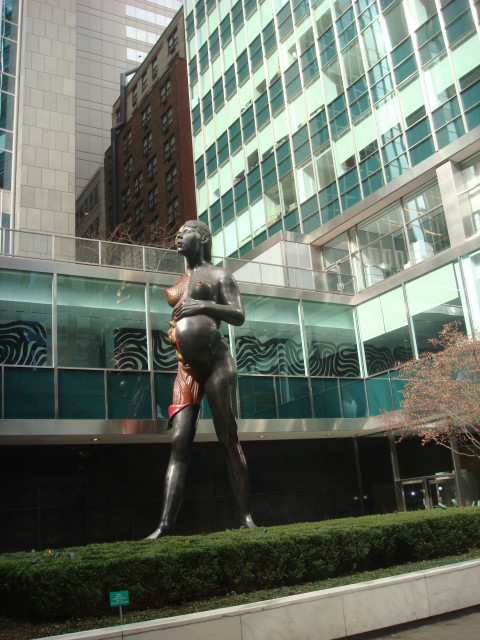
There’s an art space in an open area within the grounds.  At present, there’s a weird statue called “The Virgin Mother” by Damien Hirst.  I guess he has all sorts of “art” reasons why it is great, but I must confess that I found it..unmoving.

20080222-lever-house-02.jpg

Yep, it’s a nude woman; but more than just nude.  The artist want’s to show us what’s underneath, so he has it with cut-away flesh to show the baby within and the muscle below.

dsc06699.jpg

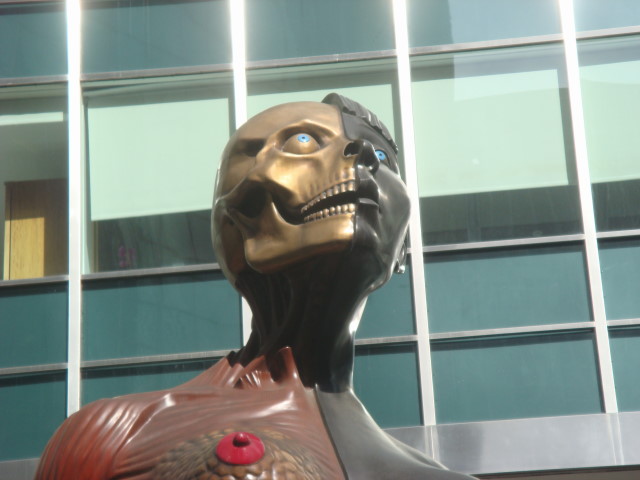
And strips away the face, at least in part.

20080222-lever-house-04.jpg

My guess is that the artist is trying to be provocative by citing the virgin Mary and having her nude and beyond.  And it is…well, the only thing I’ll say is to quote from a song from the movie “Popeye” where Olive Oyl is trying to say something good about Brutus and simply comes up with “and he’s large”.  Yes, it’s a large sculpture.  Mr. Hirst can be proud of that.  Yep, it’s large.

 Although I’m not fond of a lot of art, my distaste towards this arises from the abomination around town called the Bodies Exhibit that I can’t stand.  Oh, and if you thought you were to think the sculpture is “educational” in any way, note that the flap of skin on the thigh.  That shows that this is supposed to be more an evisceration than an X-ray view beneath the skin.

-H

Ankling to Cooper Union

March 5, 2008

You know, I always thought it was “Coopers Union” and not “Cooper Union”.  But three plaques say it is “Cooper Union”.  Not a huge wording difference, but I guess it could mean the difference between a guild of barrel makers and a place founded by somebody by the name of “Cooper”.

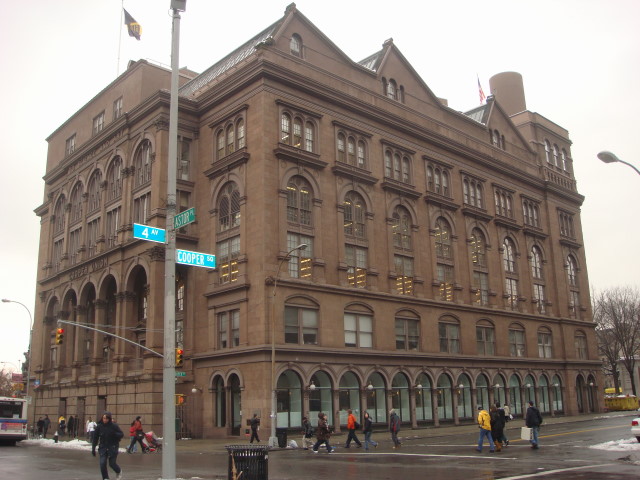
And what is Cooper Union?  Well, here it is below, located at the corner of 4th Avenue, Cooper Square, and Astor Place.  Yeah, three adjoining streets; including the mysterious “4th Avenue” which disappears north of 14th Street.

20080223-cooper-union-06.jpg

But that’s just a building.  Cooper Union is actually the second of my above possibilities: “Cooper Union for the Advancement of Science and Art“, a very selective and august university.  It was founded in 1859 by Peter Cooper and is known for giving full scholarships to its students.  Cooper was an industrialist and inventor.  He designed the first American steam locomotive, the Tom Thumb; and, according to Wikipedia, has a certain claim on the invention of Jell-O.  Now, that’s a diverse set of achievements.

But the building itself is also an achievement.

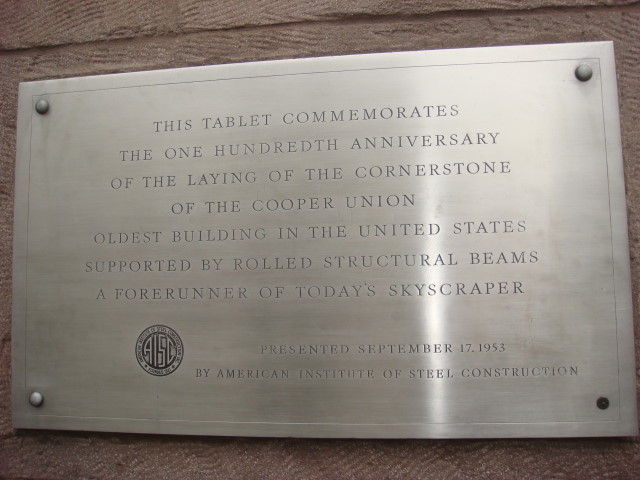
20080223-cooper-union-01-plaque-1.jpg

According to the plaque above, the Union building is the oldest building in the United States supported by rolled structural beams, a forerunner of today’s skyscrapers.

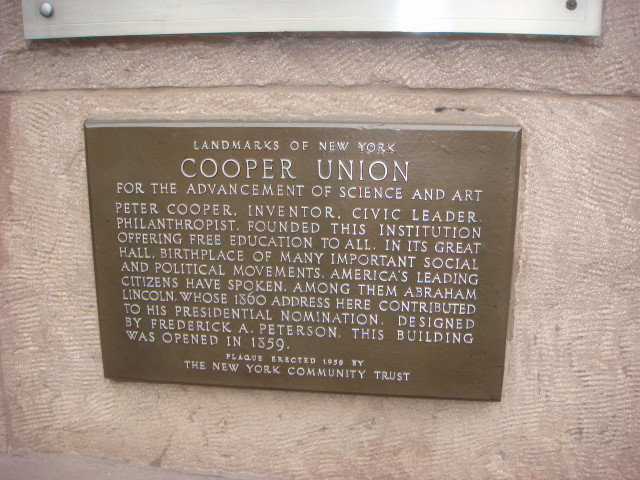
The next plaque is for both the school and the building.  It states “Cooper Union for the Advancement of Science and Art – Peter Cooper, inventor, civic leader, philanthropist, founded this institution offering free education to all.  In its great hall, birthplace of many important social and political movements, American’s leading citizens have spoken.   Among them Abraham Lincoln, whose 1860 address here contributed to his presidential nomination.   Designed by Frederick A. Peterson, this building was opened in 1859.”

20080223-cooper-union-02-plaque-2.jpg

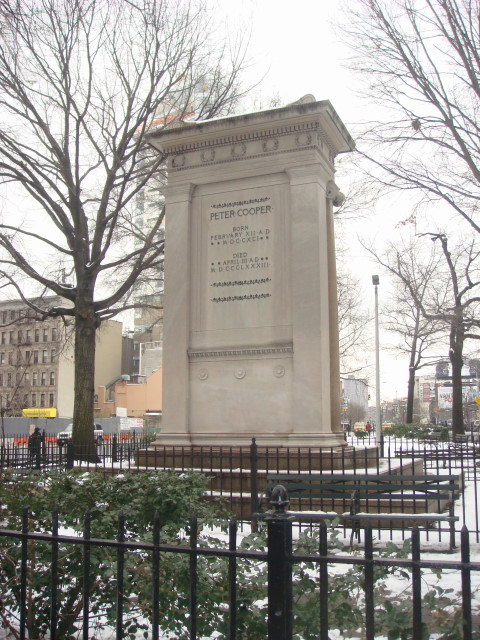
Right next to the Union is a square named, appropiately, Cooper Square.

20080223-cooper-union-07-park.jpg

The monument in the middle gives Cooper’s name and birth/death dates (February 12, 1791 and April 3, 1883, respectively).

-H

The Timekeeper Building

March 4, 2008

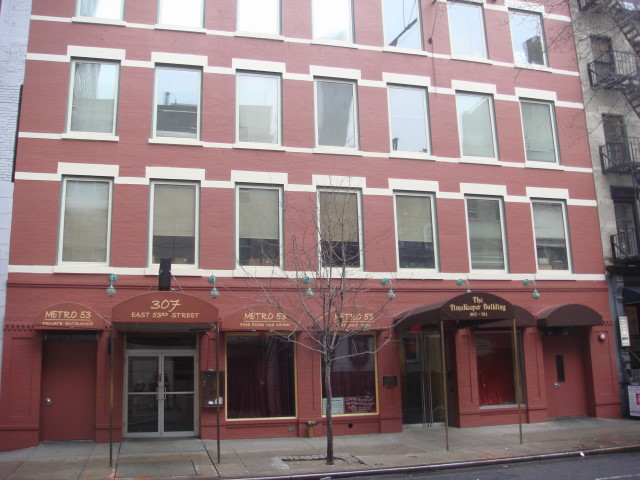
On East 53rd is a modest looking building with a cool name:  The Timekeeper.  Originally, it was a factory building.  Sad to say, I couldn’t quite fit it all into one frame.

20080222-timekeeper-01.jpg

 And, of course, it was originally know for its production of….cigars.  Okay, later it became known for its work in…specialized woodworking.  It’s now known for…being an office building.

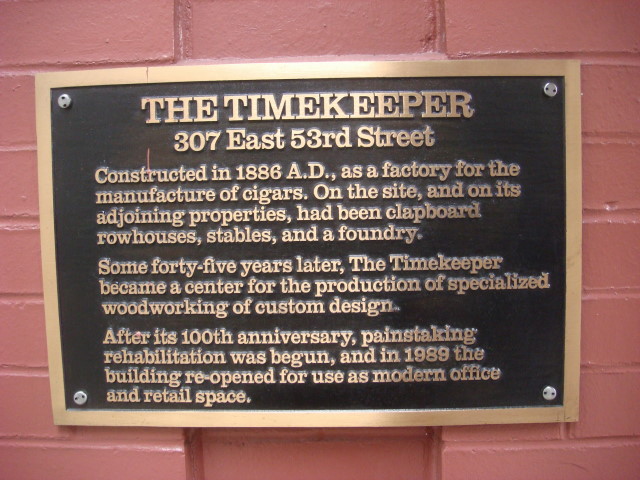
Here’s the plaque:

20080222-timekeeper-02.jpg

It reads:  “The Timekeeper – 307 East 53rd Street – Constructed in 1886 A.D., as a  factory for the manufacture of cigars.  On the site, and on its adjoining properties, had been clapboard rowhouses, stables, and a foundry.  Some forty-five years later, The Timekeeper became a center for the production of specialized woodworking of custom design.  After its 100th anniversary, painstaking rehabilitation was begun, and in 1989 the building re-opened for use as modern office and retail space.”

 I haven’t the foggiest idea why it is called “The Timekeeper”.

-H

The Forbes Magazine Building

March 3, 2008

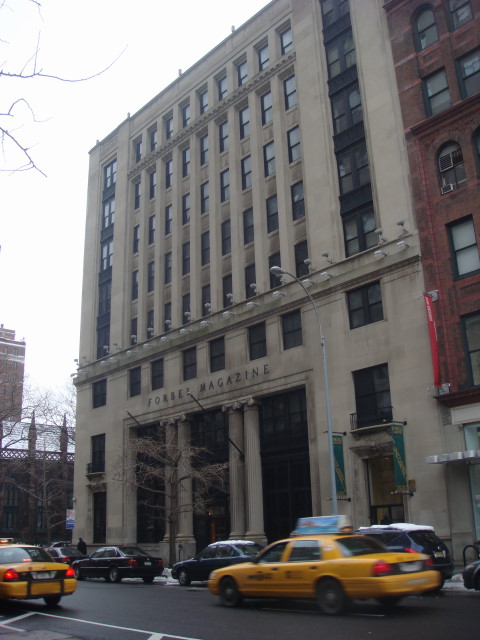
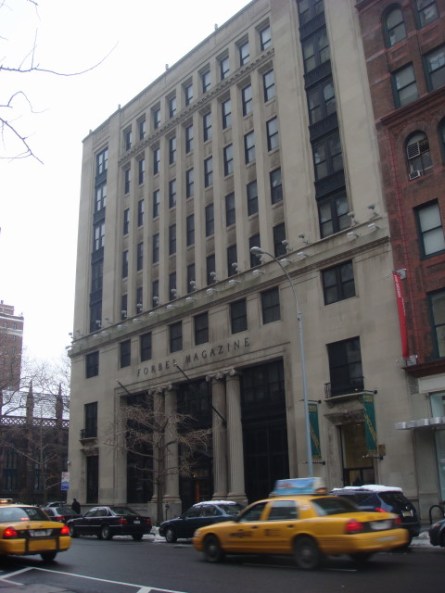
I was recently heading down Fifth Avenue toward Washington Square when a interesting looking building caught my eye.
20080223-forbes-magazine-01.jpg

It wasn’t anything more than the columns that I noticed and then, looking closer, I discovered it was the Forbes Magazine Building, located at 13th Street and Fifth Avenue.

I’m no longer a subscriber, but it isn’t the magazine that I was thinking about when I saw it.  It was the toys!

Yes, the toys.  Malcolm Forbes was a collector of all sorts of stuff and his most reknowned collection…okay, his second most reknowned (the Fabrage eggs would be #1)…is his toy soldier collection.

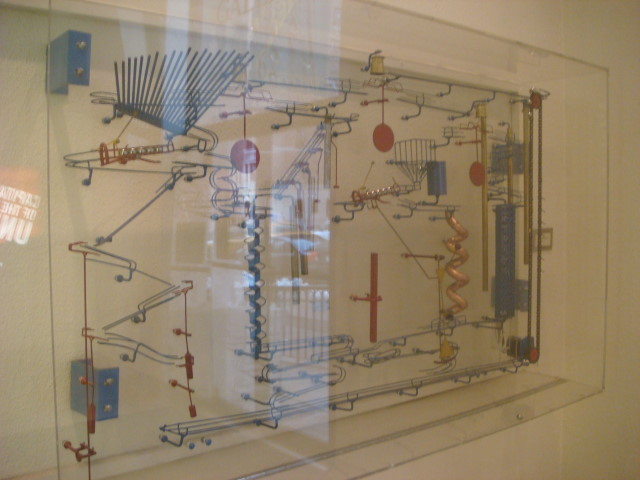
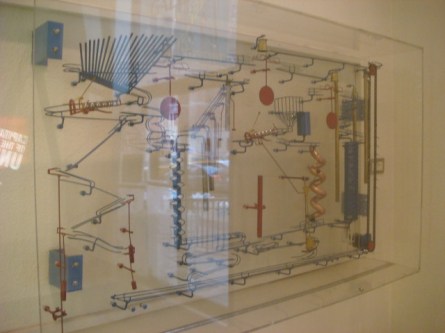
As I entered the building, a couple of things happened.  First, there was a bit of wall art that caught my eye.  It was a sort of toy-rolling-balls-with-clanging-sounds sort of thing by “George Rhoads”.  It took a quick picture.
20080223-forbes-magazine-02-george-rhoads-wall-piece.jpg

There was usually one ball in motion zipping around in this contraption and about every minute or two, seven or so balls would kick into action with lots of useless movement and noise.  I loved it.

Another thing that caught my eye was a request not to take pictures.  Oops.  So, the interior of the place is only going to be textually described.

The Forbes Gallery (it’s on the first floor) is open to the public where the rest of the building is still in use for publishing the magazine.  When you first go in, you have several possible routes.  Mine was straightforward:  where are the soldiers?  Thataway, I was told.  So, I went thataway.

They weren’t the first to be shown.  The first stuff was toy boats.  Magnificent, wonderous, perfect toy boats.  Hundreds of them.  They were exclusively not modern.  I didn’t notice anything that looked less than 50 years old.  Most looked much older than that.  I got the feeling that these were Malcolm’s and, being raised a child of wealth, he got every one he ever wanted (and he wanted a lot of them).  They were shown with very few placards, but mostly as if to say:  “I got a zillion of these things, here they are in bulk.  My collection is the greatest in the world!”

And, by George, it probably is.  They were mostly steamship-type boats and they looked like they had a complete life and a wonderful time on small ponds throughout NYC over the years.  None of them, at least offhand, looked like a true collector might want them:  absolutely pristine and without blemish.  Instead, they looked like they had been played with a lot by a boy (or a bunch of boys) with every intention of enjoying them to the max.

A couple of more rooms held the toy soldiers.  “Soldiers” is being too narrow.  Lots of soldiers and lots of cowboys and Indians and lots of Aztecs and lots of Greeks…and lots of others.  They were made of tin, and lead, and sawdust, and everything.  It was a complete collection of lots and lots.  You didn’t have one or two soldiers.  Nope.  You had hundreds arranged in an action scene.  And each type of army or group had its own scene.  I confess that I’m glad I never saw it when I was a kid because my green plastic army men would have never satisfied me again.

But I bet Malcolm never had the great wars with his guys that we had with ours.  Our great joy was to use rubber band shots to simulate the warfare and I doubt Malcolm would have let his suffer under that sort of assault.

But I loved his collection.  Wow.

Another room held the first Monopoly set ever.  If you’ve heard of the oldest one, it’s round and mostly handprinted.  He even has the earlier versions of it, back in the days it was called “The Landlord’s Game”.  Very, very impressive.

There were other rooms filled with artworks and a necklace exhibit.  The artwork was mostly cartoons by Ronald Searle and the necklace exhibit was not what I would have expected.  Instead, it was mostly plastic and glass necklaces, all done by hand by Monica Searle (I don’t know about any relation to Ronald Searle, but I would suspect there is).

A rather unusual collection that’s also there is old trophies for unknown people.  Well, that’s not right.  It’s trophies that ended up in flea markets and the like.  Their original winners’ names may be on them or not, but the trophies have provided their fleeting accolades on people and since been discarded by them or their heirs.  It’s a little strange.  But that’s fine by me.

-H