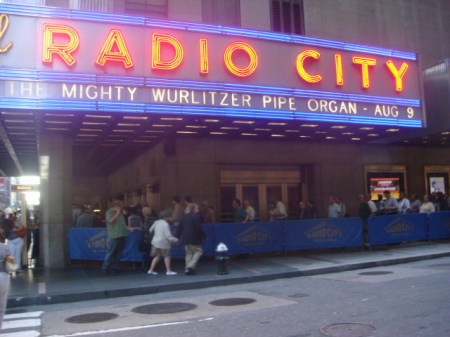
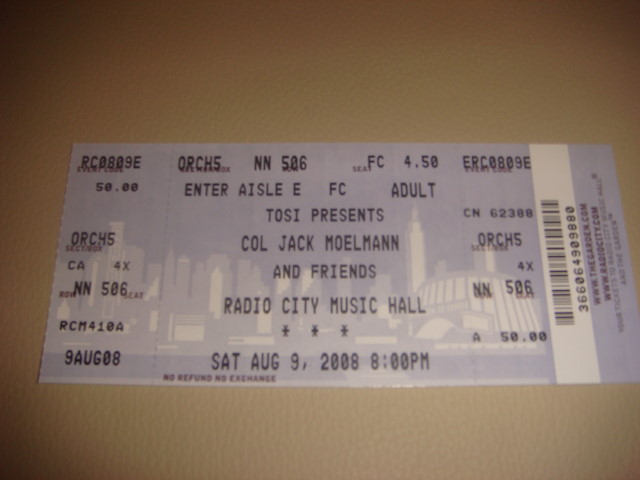
About two weeks ago, I got an e-mail from my cousin in Florida mentioning some retired Air Force colonel’s quest to rent out Radio City Music Hall’s auditorium to play the organ. I hadn’t heard a word about Colonel Jack Moelmann up until that point and the storyline probably wouldn’t have caught my attention without her pointing it out.
I thought about it and thought about it; and finally decided to go.

I must admit to not being too much of an organ fan. It’s a fine instrument and the one at Radio City has, with some qualifications, claim on being one of the biggest in the world. Hey, they call it “the mighty Wurlitzer pipe organ”. That’s a very cool name.
I have to admit that I’ve never gone out of my way to listen to the organ, except in Iron Butterfly’s In-A-Godda-Da-Vida and Bach’s Tocatta and Fugue (the last link actually has a sound file). Neither was played last night, but I think the last one would have brought the house down. My best memory of an organ itself is meeting the uncle of a good friend and watching him build part of a world class organ for a large Virginia church. Amazing.
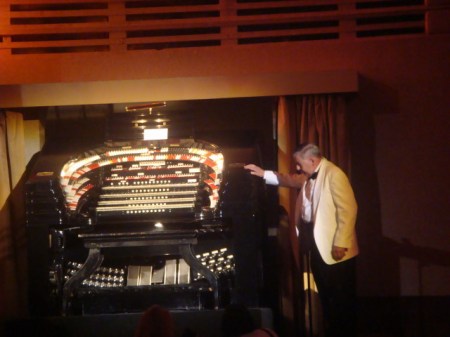
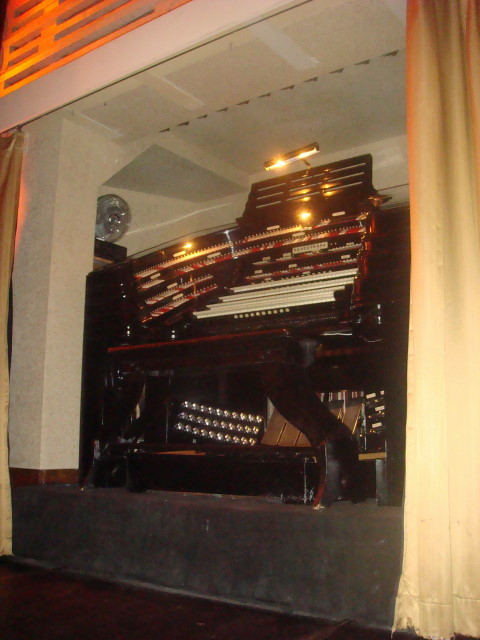
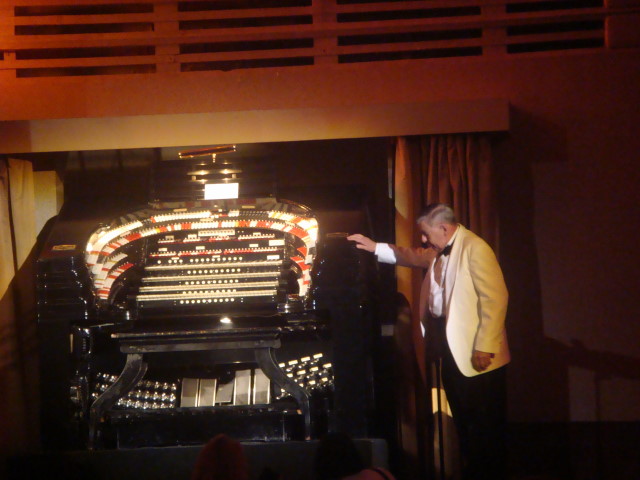
So I got in and had a pretty good seat. There are actually two organ consols in the place. One to the audience’s left and one to the right. I made a guess that the one on the left would be the focus of the performance and before the show started I managed to catch a quick photo. This is the last of the “good” photos because they banned flash photography. I gotta bunch of lousy pictures. You’re going to see the best of the worst from here on out.

At first, the place was pretty empty and I wondered about the turnout. I was pretty much there to support a retired Air Force colonel (just like my dad was) and his pursuit of his lifetime dream. (Actually, I don’t know how long he had the dream but I like to think of it as a longtime, even lifelong, quest.)
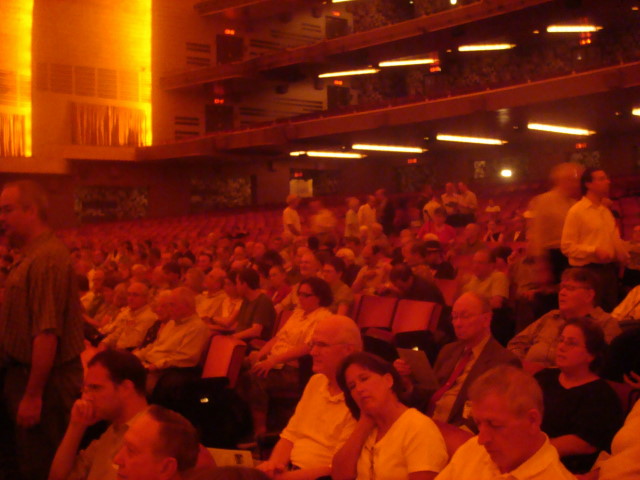
Radio City Music hall has about 6,000 seats from what I understand. The place did start to fill up, but I don’t think it hit the halfway point which is what I figure he would need to break even. The crowd was pretty eclectic, but certainly skewed toward retired types that appeared to be retired military.

Well before the above picture took place, something very nice happened. I was sitting there and some guy in a white jacket appeared and talked to some people near the front. I really only noted him because of the white jacket and how out of place it was. He then went to a couple of other rows and I started to suspect it was the Colonel. I hadn’t seen any interview or any picture that I could recall.
As he did a little bit of wandering, he came and started talking to some people two rows ahead of me and their words indicated it was Colonel Moelmann. He started talking and I recognized one of his phrases from an article I read; something about the Rockette’s wouldn’t come because they cost $90,000.
I shoulda taken a picture, but I didn’t. Interestingly, nobody near me did either. I just couldn’t believe that the show’s star was coming out to greet his audience only about 15 minutes before the show.
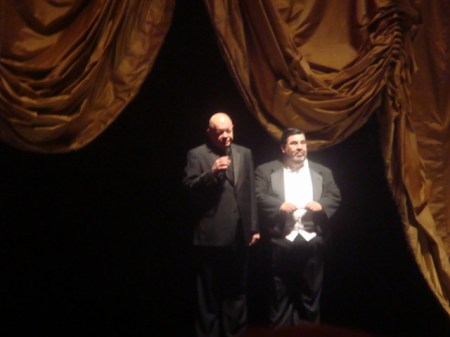
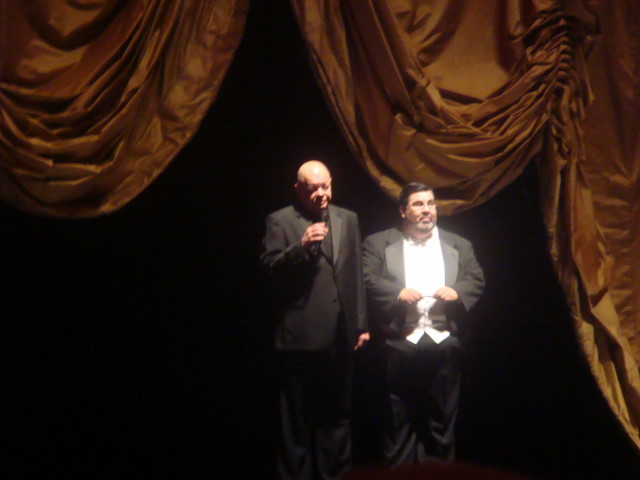
Anyway, the show started with an introduction by Fr. Gus Franklin and Nelson Page. They were front and center on the stage, but that area wasn’t used again until the very end of the show.
After about a two-minute intro, Jack Moelmann came out and climbed onto the organ’s seating. For the period of his main playing time, he got on and off that thing about six times, each time we all wondered (and he wondered aloud) whether he was going to fall off the elevated perch. There didn’t seem to be much room between the back of his (movable) bench and the edge of the perch. How he didn’t fall at some point remains a mystery. Of course, the guy was probably walking on clouds anyway.
Colonel Moelmann wasn’t alone in his playing. Early on, he was joined by Russell Holmes (the pianist for the Queen Mary 2 liner) playing on the organ consol to the right. I tried to get a photo of it, but no luck.
The Colonel played for about twenty minutes or so. Most of his repetoire was pretty standard songs from the thirties and on. His first one: The Trolley Song from “Meet Me in St. Louis”. One of the most modern ones? Rubber Ducky. He did some Cole Porter, too.
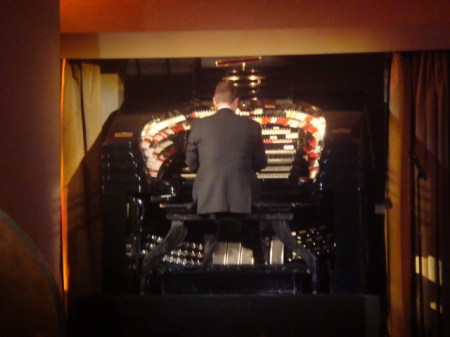
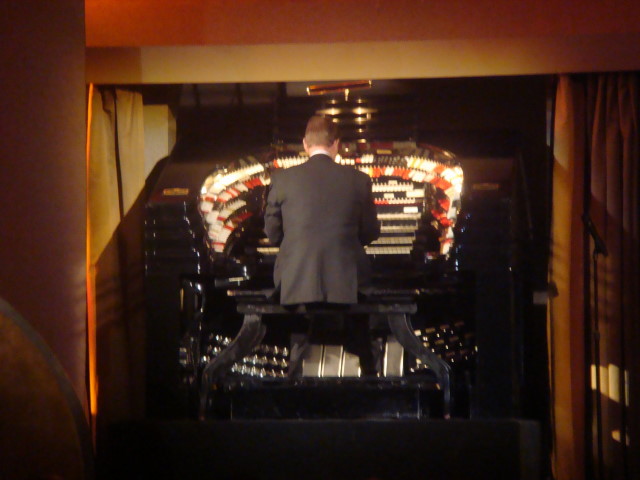
He was followed by a fellow organist, Walt Strony. The picture below is pretty much the sort of thing we saw all evening. During his conversation with the audience, Colonel Moelmann stated that one of the “rules of show business” is not to turn your back on the audience. Well, with the Radio City setup, there was no way to not have your back to the audience.
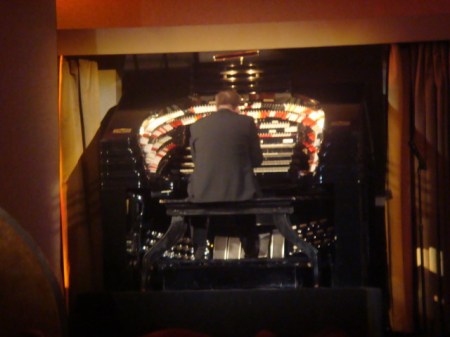
The next organist was Lew Williams. The next picture is such that both he and Walt Strony were hard to tell apart.
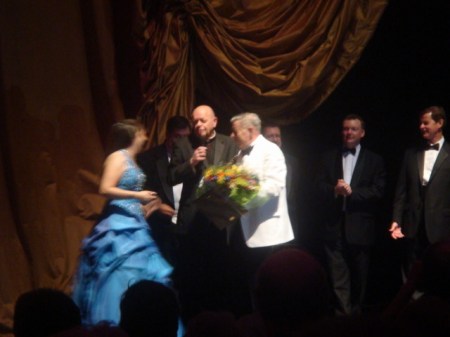
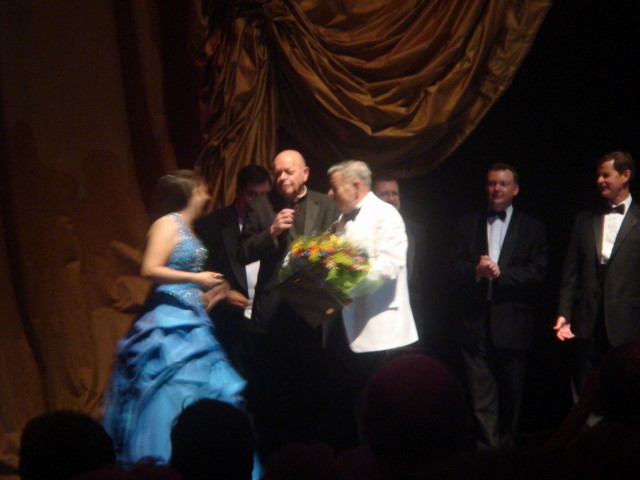
At the very end, they went to the main stage and Col. Moelmann was presented with an award from the Theatre Organ Society International. The members of his Church sent flowers and the Colonel told us to get out.
The program itself was pretty standard. There was the first medley from Moelmann. He was joined by Russell Holmes for a few tunes. Walt Strony and Lew Williams did a few themselves, giving the Colonel a chance to take a breather. He came back to lead a sing-along. There was an intermission and then each of the four did some more playing. Plus, Fr. Franklin played some at the end with Moelmann. There was one classical piece performed, I believe by Williams. Lots of Broadway tunes.
One or two items. His playing was fine, but his three main accompanists were much sharper. No problem. Second, there was so many other sounds coming along with the organ playing that it seemed that the organ was played almost as much as a synthesizer than just a regular organ. I don’t know these things, but some of the sounds were such that they may have been recorded to play at the touch of a button rather than the sound changing because of the flick of a switch. For example, some bell-type sounds were very fast and there didn’t seem to be any corresponding movement in the organists bodies to show that they were being created on the fly.
But that’s of no consequence. It was good to see somebody’s dream come true. To his credit, the Colonel said that he his main dream was to entertain us, but however you cut it; seeing him do this accomplishment was one of the main entertainments of the evening.
-H
















 Famous Ankles