Archive for the ‘Wanderings’ category

The Lower East Side and mighty good pickles

August 30, 2007

As good/wonderous/cool/interesting/artistic/gritty that the Lower East Side’s Rivington Street and Ludlow Street are; in my book, the real street in LES is Orchard Street.  Ya wanna see Orchard St? Go a bit further south than the Rivington St and Ludlow St area and cross Delancey St.  Physically and interesting-wise, Orchard actually parallels Ludlow St., but below Delancey, there’s no contest. First, Orchard St. has the historical Tenement Museum, which I would encourage you to visit if you have the chance. My favorite part of that was when I looked at one of the places they’ve restored to it “tenement” condition and saw how closely it resembles my own place (before I had it completely renovated).

But the real reason is the greatest, most wonderous, most awe-inspiring place for many a block around:  Guss Pickles.

Guss Pickles - closed

Sad to say, they are closed on Saturdays. The pickles are unbelievably good (get the spicy! Get the Spicy!! GET THE SPICY!!!!).  They sell them singly or by the small bucket. Note: this is not the place you’ll find if you google Guss Pickles. I’m told there are legal proceedings over the name and that this one on Orchard Street is the original.  UPDATE (9/8/2007):  I talked with Pat Fairhurst, owner of Guss Pickles on Orchard Street and she said the proceedings are resolved.  The other Guss Pickles has obtained the trademark, but the Orchard Street Guss Pickles can keep the name.  She re-iterated that they are the last of the “old-time pickle makers” in the LES, established in 1920 by Izzy Guss).

If you get there, you’ll discover that the storefront is a sham. You wanna buy pickles: they roll the barrels out into the street every day and you buy them there. GET THE SPICY!!!!!!!!!!!!

I like them pickles.

I once took a bucket to work and some people complained that they smelled up the place. They still grabbed three or four pickles each, but that was beside the point.

GET THE SPICY!!!!!!!!!!!!!!!!

I now have a hankering for pickles. Soon…soon…

-H

Wandering the Lower East Side (LES)

August 28, 2007

The Lower East Side is an old staple of mine.  I started visiting it well over a year ago and, until I started ankling my way around Harlem, I considered it the coolest part of Manhattan.

Despite Harlem’s cool status (and my somewhat dampened love of that place), LES is still cool.  It is also so all-over-the-place that it merits many posts over the future.  This post is just a quick jaunt to some old favorites that I’ve written about in my e-mails to friends and family.  Now, I get to add pictures.

Okay, LES (I don’t pronounce it as anything other than “Lower East Side”, but I don’t like to type that much) is known really for its historical position as the first stopping point for immigrants.  It still is, but not really.  Well, yeah; but not even close.  You see, it’s coolness makes it really expensive, but the edges are being filled in by Chinatown which has….no really evident coolness….but lots and lots of new immigrants.

Position wise, it’s on the east side of Manhattan and goes from Houston Street down to…Chinatown….which is eating it from below and from the west.  “Little Italy” (the subject of another post), is technically to the west of LES, but has now reached near invisibility status due to the Chinatown surge, but LES still seems to be hanging in there, at least mostly. Oh, on the east, LES is bordered by the East River. (Hey, that’s three “easts” in one sentence. Not bad.  Of course, I used variants of “cool” about five times so far in this post.  That’s bad, but not in a cool way.  Six.)

The whole point of the original LES was density.  It boasted the highest population density in the world during the great immigrations of the 19th and early 20th centuries.  And that’s with a relatively low-rise buildings.  They seem to usually reach maybe 3 to 8 stories.  Graffiti, noise, noisomeness, and still people are storming the ramparts to get a place in LES.  You see, LES is gritty and interesting and maybe a little bit wild; and each of those attributes is like catnip to the hipsters.  Well, LES may be “gritty” if you define gritty as dirty and graffiti-covered.  But, it is very interesting and has a strong connection with the arts.  I’m not really sure about “wild”, though.  I only bring it up because of a character I ran into some time ago who pointed out a place that I’ll save for another post in the future.  In any case, I really like LES and I think anyone who visits will leave with affection.  It’s just one of those kinds of places.

Anyway, I took the bus down to Houston Street and wandered over into LES.  I always think of three streets when I’m in LES:  Rivington, Orchard, and Ludlow.  Rivington goes east-west and the other two are north-south.

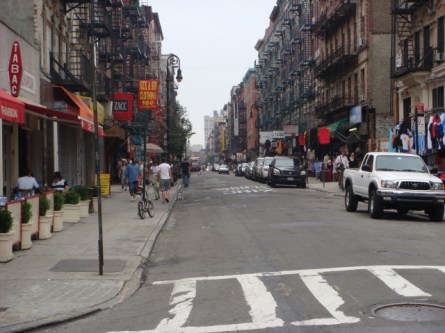
All of them are considered “cool”.  When I first started to visit LES, I spoke with a co-worker about Ludlow being “cool” and that I hadn’t known its reputation.  He laughed and replied:  “if you had a 15-year-old daughter, you’d have known.”  Here’s Ludlow Street on a Saturday morning.

LES 1 Ludlow St

LES 2 Ludlow St

And the architecture can be wonderful.

LES 3 Ludlow St

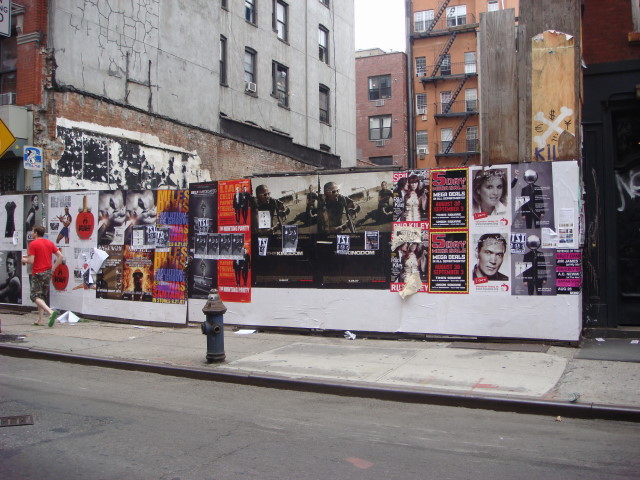
But, the gritty, artistic side still shines out.  There are places all over Manhattan that do stuff like this, but I find it more “natural” in LES.
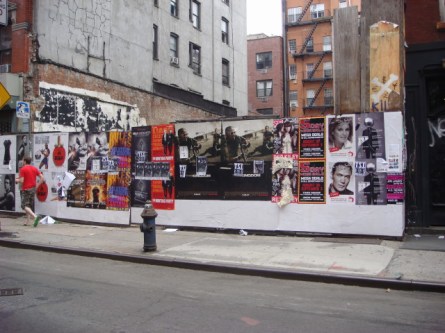
LES 4 Ludlow St

Of course, they absolutely, positively must be ragged and torn and (most importantly) duplicated.

But, then, there’s Rivington.  Rivington has two places of note, at least for Famous Ankles:  Economy Candy and TeaNY.

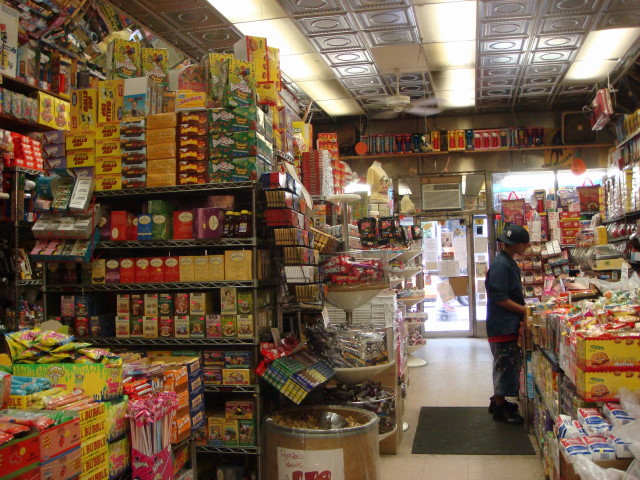
Economy Candy is simply a big candy store.  In truth, a WalMart might physically have more candy, but Economy Candy knows that displaying candy from floor to ceiling is an absolute must.

LES Candy Factory 1

LES Economy Candy 2

In terms of “art”, Economy Candy is art.

TeaNY is a wonderful, but very small tea restaurant partially owned by musician Moby.  Usually, it’s jammed and I can’t get in.  However, there are lots and lots of different teas and I can attest to how good it is from experience.  Not cheap, but not outrageous.

LES 5 TeaNY

I was astonished when I went by and saw that it was mostly empty.  TeaNY is never like that.  I wanted to go in and get some tea, but I had places to go (future posts!) and really no thirst.  I remember many times walking by and seeing the place jammed with people and really having a hankering for tea.  Ah, well…

I’m saving Orchard Street for another post.

-H

Harlem Street Party

August 22, 2007

It’s my variation on an old joke:  other than that, Famous Ankles, how was the Harlem street party?

Well, it was pretty nice, excepting the Black Panther Party scum.  The link tells you that they mugged me for a grand total of $2.

Actually, excepting the scum, Harlem was as great as ever.  It’s Harlem Week and the street party was something that I really wanted to see.  All of my previous wanderings of Harlem had been during the morning and afternoon.  I wanted to see Harlem at night, during the time that it might not be quite the same.  Well, except for the scum, it was every bit as vibrant and joyful as I could have hoped.

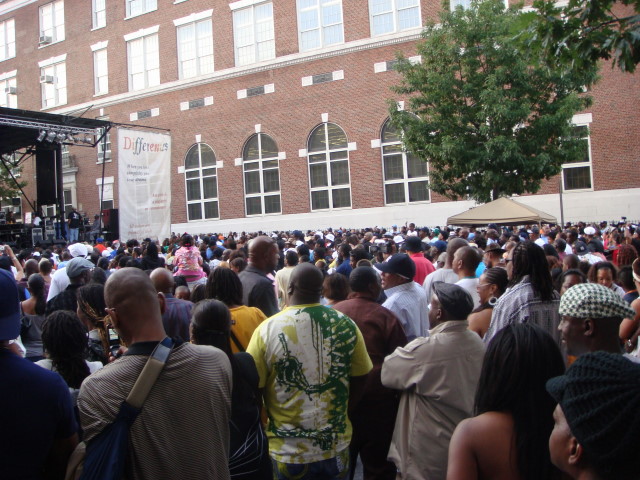
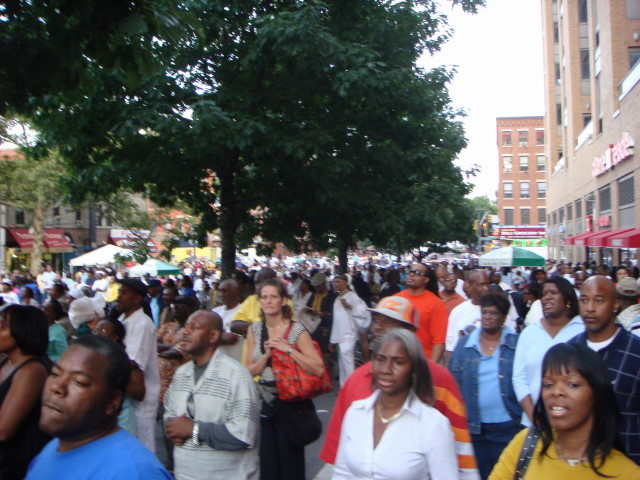
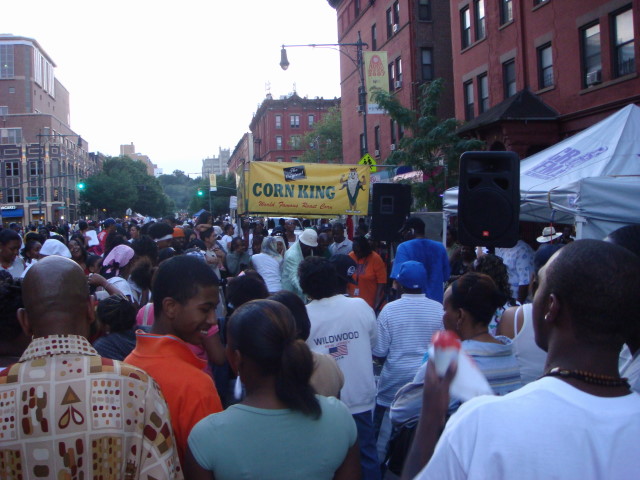
As I emerged from the subway at St. Nicholas Ave and 135th, I spotted a large stage facing away from me with a sea of people listening, watching, singing, and dancing to a live performance.  I entered the area and just started listening, watching, and taking pictures.  Famous Ankles neither sings nor dances.  But the rest of the crowd made up for it.

Harlem Street Party 1

Harlem Street Party 2

Harlem Street Party 3

The crowd knew the words and it seemed that everyone was accompanying the performers.  I eventually recognized one of the songs, but it wasn’t one of those that I really know, at least like this crowd knew.

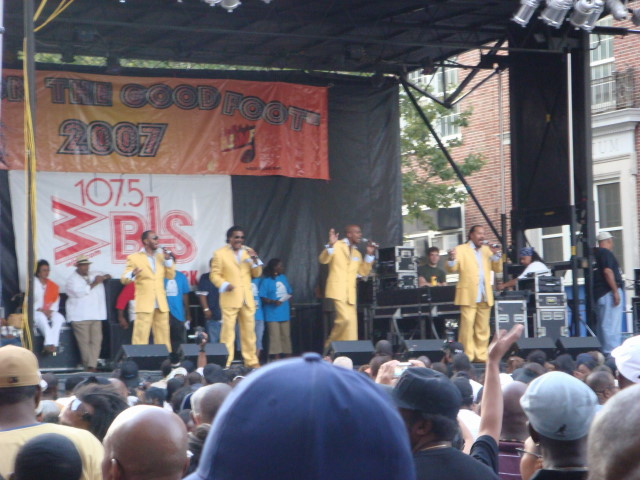
I was told that the performers were Ray, Goodman, & Brown.  I don’t know why there are four people up there with three names; but then I had to ask who they were.  Here’s a pretty poor shot of them (I was using the zoom and was a little shakier than the camera could adjust for).

Harlem Street Party - Ray, Goodman & Brown

Anyway, they sang for a while and I eventually just sort of wandered off to see the rest of the street party.  After about a block and a half, I couldn’t hear them anymore as recorded music was being played by a variety of vendors.

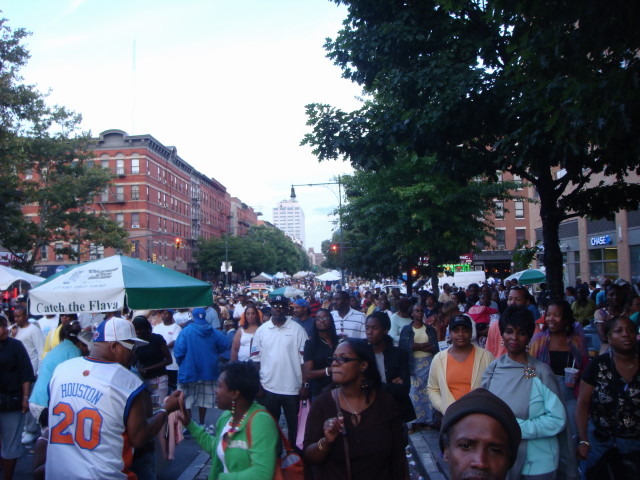
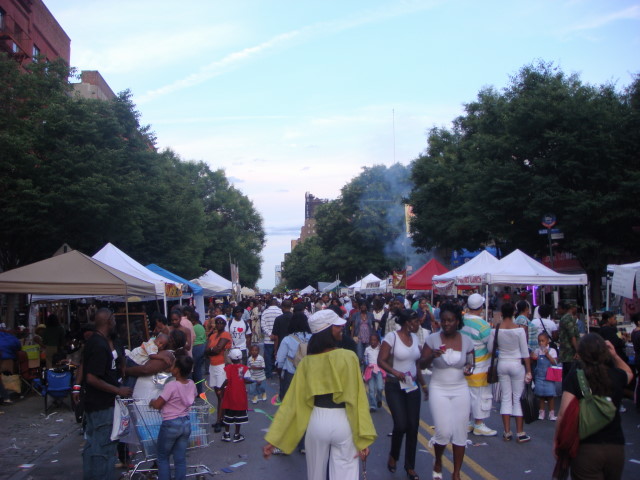
Here are some shots from further in the party.  The party covered 135th Street from St. Nicholas Avenue to Lenox Avenue.

Harlem Street Party 4

There were a lot of food and merchandise vendors.  I was actually tempted by one or two vendors, but I tend to avoid street food.

Harlem Street Party 6

As you can see, the crowding was pretty intense.  I can only hint at the boisterousness and excitement that was everywhere.  And, of course, lots and lots of music.  Very enjoyable and memorable.

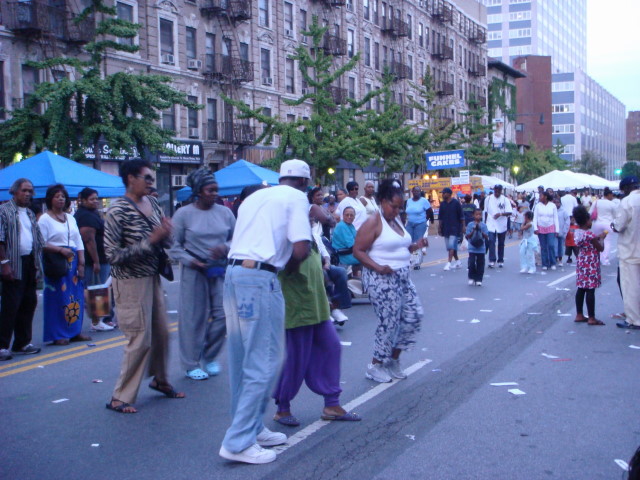
My favorite part of the entire party was some impromptu dancing that started up.  It was pretty small, and at one point a woman tried joining in and wasn’t quite successful in matching the moves of the others.  But I think we all appreciated her attempt.

Harlem street party dancers

And then I got mugged.  Or, rather, I got extorted out of $2 by the Black Panthers who resented being in part of one of my street pictures.  If you’ve looked at my post, you’ll know it’s a terrible picture.  But I put it in just to highlight the scum that were hanging around a very pleasant time.

Perhaps the worst part (other than the mugging) is that the Panthers had a pretty good following.  They had lots of people listening in to their talk.  I don’t know what they were discussing but it was probably related to their need to prove their identity by raising $2.

Incidentally, something I had forgotten about until writing this: earlier in the day when I was going through Park Slope, I was walking on the street and found, of all things, two one-dollar bills just being blown down the sidewalk. It honestly hadn’t occurred to me that my mugging was just a part of a zero-sum chain of events.

The Panthers are, nonetheless, scum IMHO.

-H

Wandering Brooklyn’s Grand Army Plaza

August 21, 2007

My latest posts have been about my wanderings out and about Brooklyn on Saturday, August 18th.  Here’s another.

What can I say?  It was a busy day.  I still have two or three posts left that cover the weekend.  It may be for the best because this coming weekend’s weather may not be quite as accommodating as last weekend’s.  In any event, I sure hope it doesn’t include another mugging.

Anyway….this post isn’t about next weekend, but about my Park Slope (Brooklyn) wanderings.  Where we left off, I had managed to aimlessly wander around the ENTIRE PARK!!!!  What was I thinking?  I’ll tell you what I was thinking:  “I need to get to Grand Army Plaza and get something to eat.”  Ahhh, sophisticated thought processes on display there, eh?  (Truth:  it’s a big park, but it is walkable.)  When I finally did spot Grand Army Plaza, it was a moment of pleasant relief.

Grand Army Plaza is a huge area built up and around a plaza and it is grand, indeed.  The centerpiece of the plaza is the Soldiers’ and Sailors’ Arch.  (But to confuse you, there’s a Grand Army Plaza in Manhattan, too.  It’s where the Plaza Hotel is, right at the southeast corner of Central Park.  Brooklyn’s Grand Army Plaza is at the northern tip of Prospect Park.  Both parks, as noted in my earlier post, were designed by Frederick Law Olmstead.  Maybe he had a thing about grand armies…)

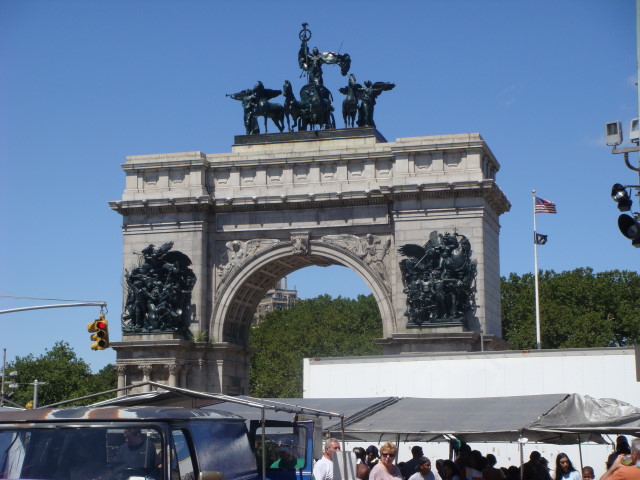
Here’s a pic of the arch.

Soldiers’ and Sailors’ Arch

It is part of Park Slope, but it seems more or less a place all to itself.

I’ve been there before and each time, there’s been a Famers Market.  You can see part of it at the bottom of the picture of the arch.  NYC is big on farmers markets.

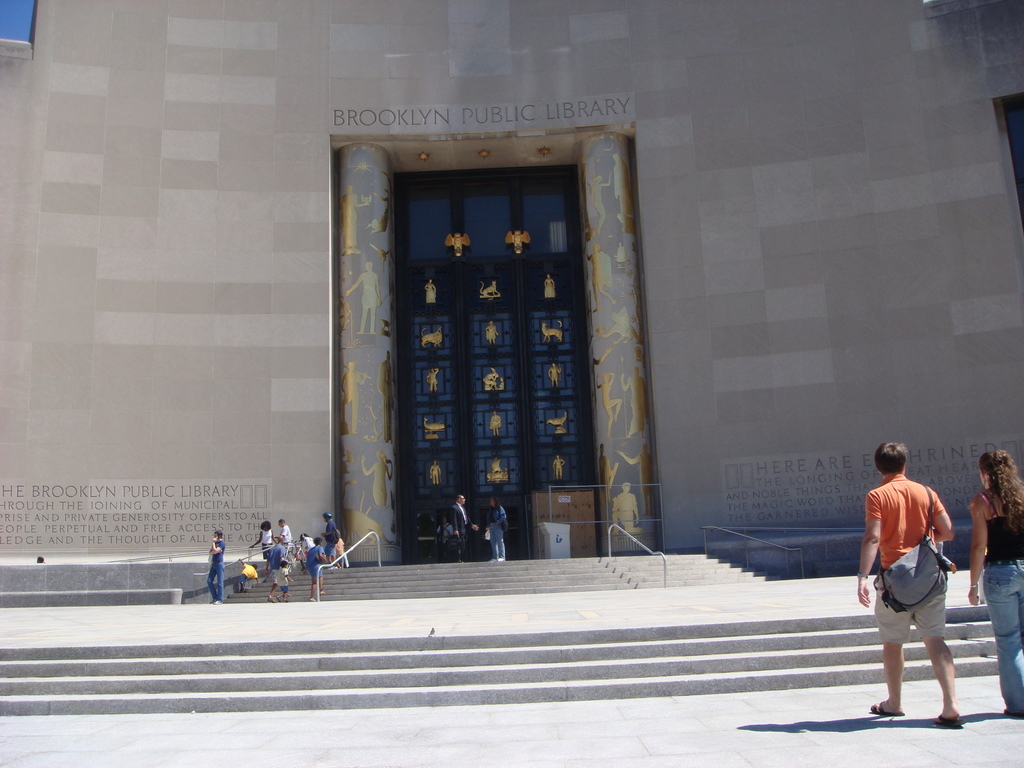
I was pretty tuckered out when I got to this point.  I did notice the Brooklyn Public Library just to the side and just had to go in.

Grand Army Plaza

It’s pretty nice inside, but not quite the New York Public Library, which has an entry beyond compare.  I still owe you a photo regarding my Brooke Astor post.  Soon…

Oh, there doesn’t really seem to be any places there that I wanted to eat; so I went a few blocks back to 7th Avenue and found the Tex-Mex place I mentioned in the Park Slope post.  It wasn’t worth walking the few extra blocks.  Well, I’ve gone further for worse, so no real complaint.

-H

Wandering Prospect Park

August 20, 2007

As part of my planned Saturday wanderings in Brooklyn, I decided to take a quick look into Prospect Park.  It turns out to be far more of a look than planned.  I essentially walked the entire perimeter of the park.  It’s a big park and I got pretty tired during the walk.

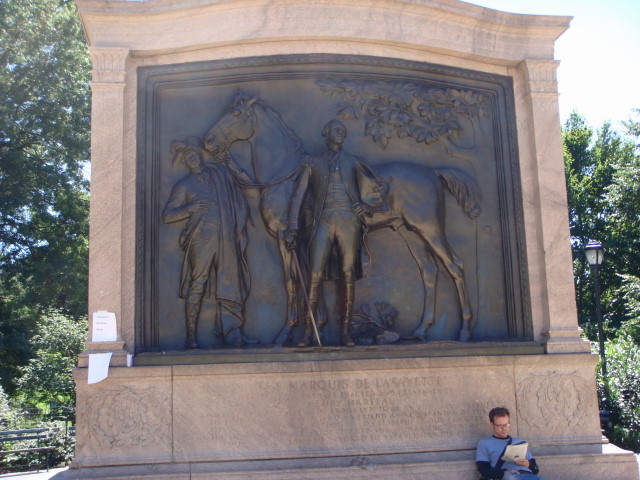
I reached the park after going through Park Slope, which is just to the immediate west of Prospect Park.  I think I was on 9th Street and I did enter at the Lafayette entrance.  I don’t know if that’s the actual name, but there’s a dedication to him at the entrance.

Prospect Park entrance

The area just inside the entrance was set up for a big birthday party for a little kid.  Happy Birthday kid…whoever you are.

Frederick Law Olmstead was the primary architect of both Central Park and Prospect Park.  They are very different, but they both share one feature that even Famous Ankles can notice:  complexity and diversity of the areas.  Neither park can be described simply.  You can’t take in the parks at a glance or even with a dozen different perspectives.  They are designed to have distinct areas, each with its own identity and, usually, a distinctive name.  In Central Park, you’ve got such places as the Great Lawn, the Sheep Meadow, the Ramble, and Poets’ Walk.  Prospect Park has lots of names, but they don’t strike my ear as familiar as those in Central Park (whose places I had heard of before moving to NYC).  That doesn’t make them any less attractive.

The most immediate difference I saw between Central Park and Prospect Park is the lack of fences in Prospect Park.  Central Park has a lot of fenced-off areas; or at least areas that are fenced off at various times during the year.  I wandered for a while in Prospect Park before I saw my first fenced-in area.  It’s an equestrian area where two women were taking horse riding lessons.  There were also two instructors, one of whom seemed to enjoy yelling at one of the riders.  It wasn’t English…but in NYC it can be anything.

Riding area

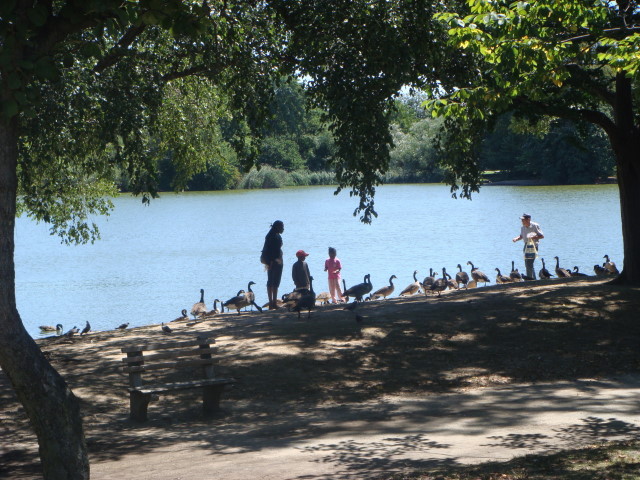
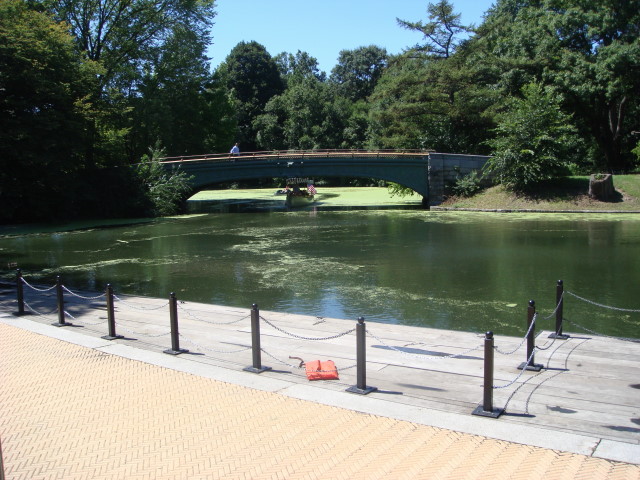
I continued walking and ran into Prospect Park Lake at the far south tip of the park.

Prospect Park Lake 1

It looks like Goose Heaven to me.

Prospect Park Lake 2

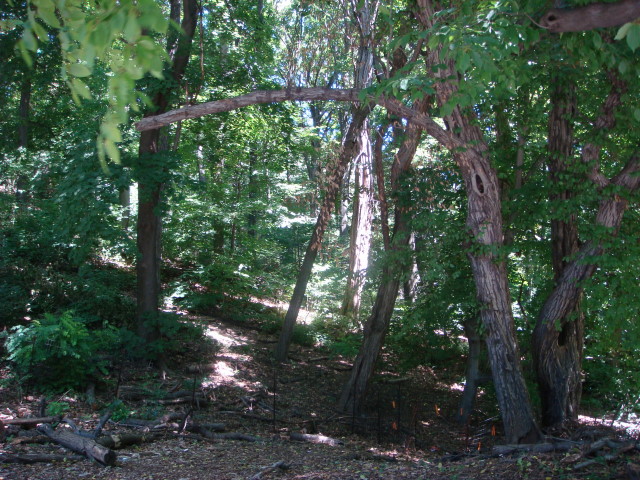
And that leads to a second difference between Prospect Park and Central Park:  wilderness areas.  As beautiful as Central Park is, there’s very little unplanned space in it.  At times, it seems that every blade of grass is planned.  Central Park has an area called “The Ramble” (an old favorite of mine) which is relatively “wild”.  But even it is very well planned out.  In contrast, Prospect Park has lots and lots of “wild” areas.  (I saw an interview where a Park employee said they had the last true forest in NYC.)

Wild areas 1

Wild areas 2

Okay, the last seems pretty planned, but it wouldn’t look that way in Central Park.

The biggest difference, at least for me, is really the people.  On a weekend like this one, Central Park is usually much more crowded.  There are a lot of runners/bikers in the streets in both places, but I don’t think Prospect Park had more than a relatively small fraction of that population in Central Park.  I did note that the hilliness of Prospect Park made some of the bikers and rollerbladers go a lot faster than anyone I’ve seen in Central Park.

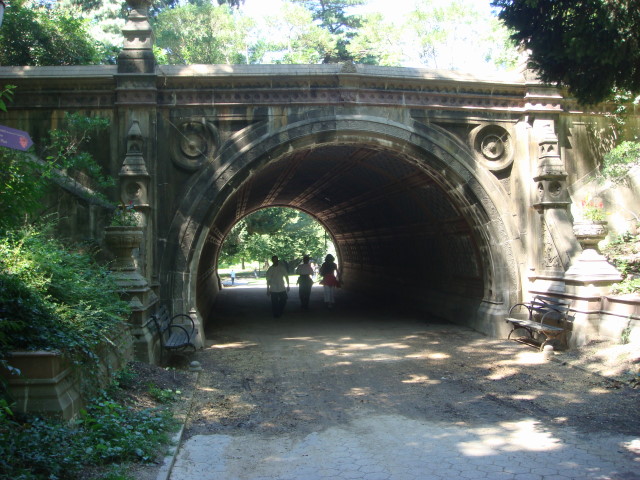
But, both parks were done by Olmstead and there are lots of similarities.  I’ve mentioned the “sections” that both parks consist of.  They both also have a number of tunnels in the walking areas.

Prospect Park underpass

They both have “boathouses”.  In Prospect Park, it’s near the Audubon Center.  Central Park’s boats are individualized (you rent them and paddle yourself).  What I saw in Prospect Park included a sort of micro-cruise ship.  Here’s that boat coming under an overpass (unique to Prospect Park, too).

Audubon Center area

It’s tiny, but it is powered by something other than oars.

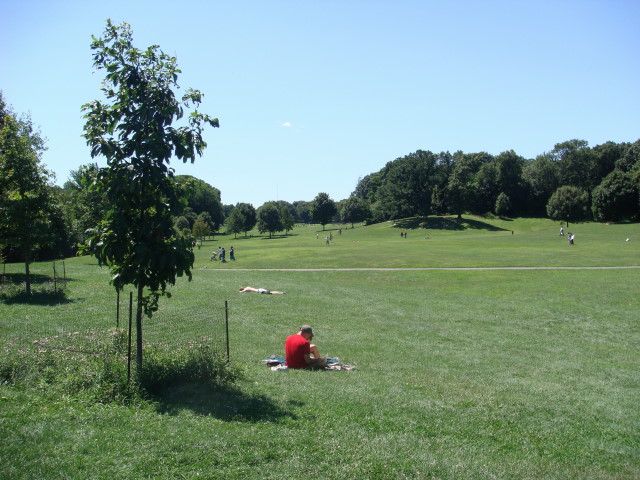
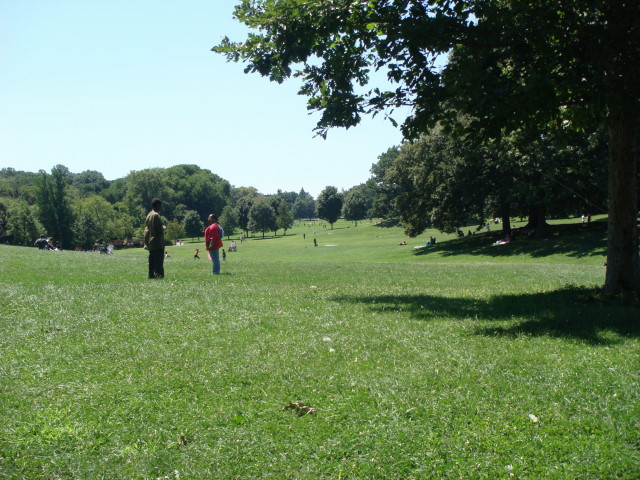
Okay, but there’s one thing that Prospect Park has that Central Park doesn’t:  the Long Meadow.  Stretching from Prospect Park Lake in the south to the northern tip, the Long Meadow is a grassy open area several hundred yards wide and who knows how long.  It meanders all over the place and is a combination Sheep Meadow and Great Lawn and beyond.  In Central Park’s Sheep Meadow, people often just cluster to sunbathe.  In the Great Lawn, they play organized sports (reserved times and everything).  In Prospect Park’s Long Meadow, they do both and anything else they feel like.  It’s nearly perfect.  I can hardly say enough in its favor.

Long Meadow 1

Long Meadow 2

Long Meadow 3

The last picture is from near the northern tip of Prospect Park.  At that point, you enter back into Park Slope.  That area is Grand Army Plaza (the subject of another post).

-H