Archive for the ‘Manhattan’ category

What lies below Chinatown?

February 19, 2008

A confession.  I always comment about the size and growth of Chinatown and how it is enveloping all of Little Italy.  I’ve wandered throughout Chinatown, but I had never, ever just gone through Chinatown to reach the other side.  It’s a weird “confession”, but I was noticing that my own ideas of Chinatown seemed to have it go all the way from Canal Street to…well, I hadn’t given it a huge amount of thought.

There is an “end” to Chinatown.  As I went through Chinatown recently, I decided I’d travel until I reached the other side.  I knew where it was, but just had never made that particular transition (I’d always turn around near the bottom and head back up).  It ends in the government area of Manhattan, right near where the courthouses are that you’ve seen on Law & Order and every other NYC cop/lawyer show when they want to show the institutes of justice in the City.

20080202-courthouse-02.jpg

There are two big ones, plus a plethora of standard government office buildings.
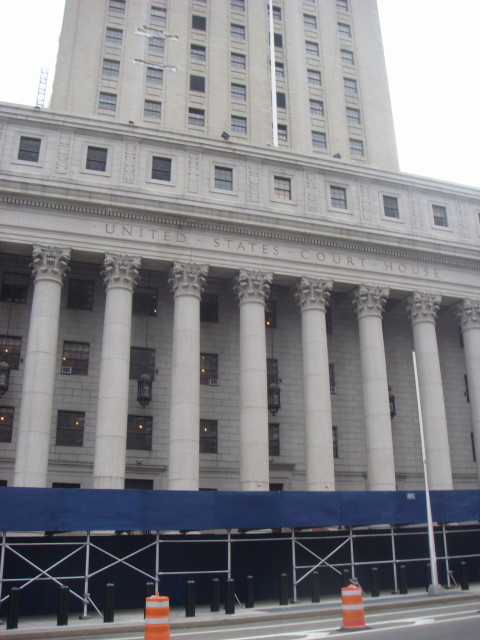
20080202-courthouse-03.jpg

Right across the street from them is Foley Square.
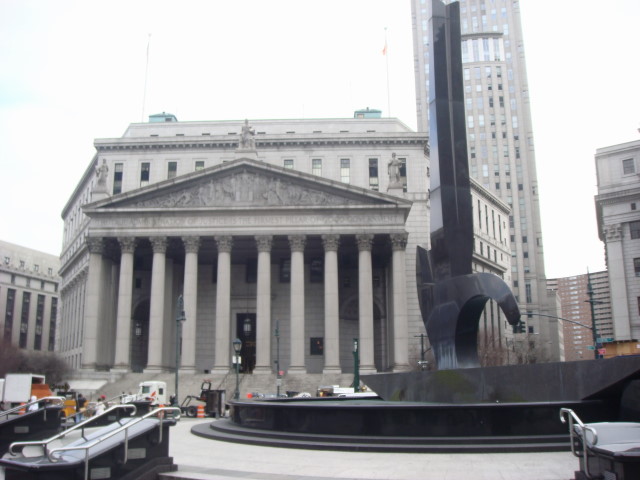
20080202-courthouse-01.jpg

The sculpture in the fountain is based on something called a Chi Wara, a type of African headdress that itself is a symbol of the antelopes of West Africa.
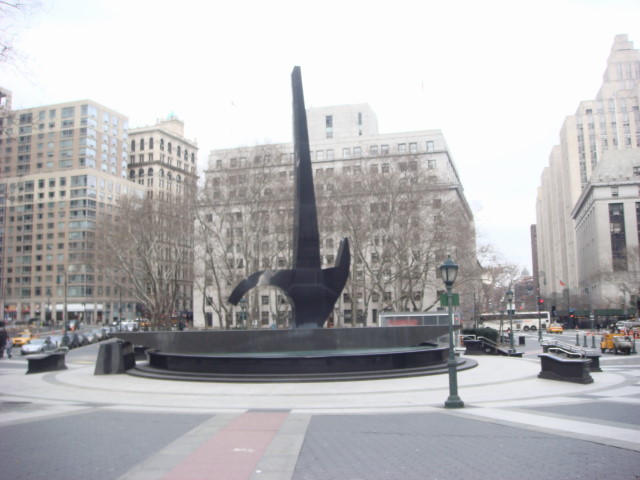
20080202-courthouse-04-foley-square-chi-wara.jpg

The writeup on the Chi Wara talks about how it symbolizes the antelopes which symbolize men and women working together to produce a good harvest.  Well, I’m sure they’re also being symbolic to mean something other than successful farms in Lower Manhattan. 

Forgive me.  I’m having too much fun with the idea of a symbolic symbol symbolizing harmony.  Is the harmony symbolic of something else?

Incidentally, Foley Square is named after one of those behind-the-scenes-politicos of yesteryear who was the mentor of Al Smith, one of Gotham’s great mayors.

So, I wanted to write about going through Chinatown and hardly said a word about Chinatown itself.

-H
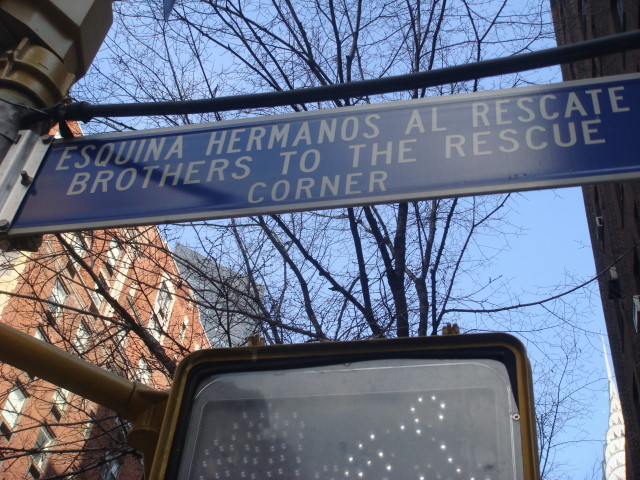
An International Tweak

February 18, 2008

I pass by the corner of 38th Street and Lexington on a regular basis.  I know the area pretty well, but just recently looked up and saw something I hadn’t noticed.

20080127-38th-st-and-lex-street-corner-01.jpg

There are a lot of streets in NYC that have two names.  It will be a street number and an honorary name on a blue sign.  I hadn’t noticed this one because I don’t really read them anymore, but this time I did.  This one is relatively unique in that it isn’t a honorary street name, but a corner name:  “Brothers to the Rescue Corner” or “Equisna Al Hermanos Rescate”.

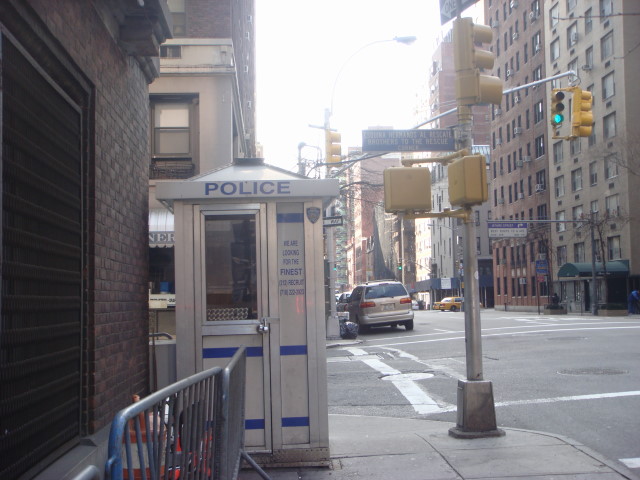
If you step back, you’ll notice that there is another unusual feature to this corner:  a police box.

20080127-38th-st-and-lex-street-corner-02.jpg

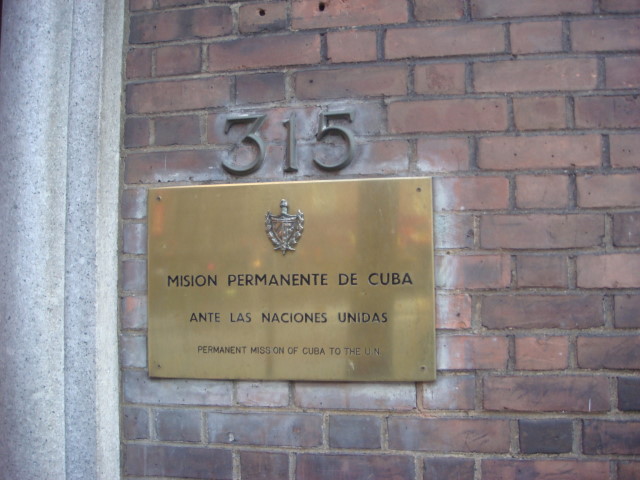
Once again, you see these around, but it isn’t a random placement.  The cop is there in response to one of the block’s residents:  the Cuban mission to the United Nations.

20080127-38th-st-and-lex-street-corner-03.jpg

The “tweak”?  Brothers to the Rescue is a group of Cuban exiles that used to fly near Cuba searching for Cubans fleeing by raft.  Later, they engaged in a leaflet dropping operation that would go near, and sometimes inside, Cuban airspace to drop leaflets to be blown onto Cuban soil.  If you read the Wikipedia link, you’ll see all sorts of governmental machinations including a probable Cuban infiltrator of the group and a host of different sources saying opposite things.  During its rescue/leaflet flights, the government of Cuba protested the actions until, in 1996, they shot down two of the group’s airplanes.

The point of naming the corner after the group is simply to remind Cuba that they are viewed as barbarians willing to kill unarmed leaflet droppers rather than to let them speak their minds.

I suppose Cuba has retaliated in some similar diplomatic fashion.

-H

Temple Emanu-El on the Upper East Side

February 16, 2008

From what I understand, this Temple is the premier Reform Jewish house of worship in NYC.  The building itself certainly is impressive.

20080126-temple-emanu-el-05.jpg

It is just massive and impressive.  It does have a Wikipedia article that goes through the history of the Congregation:  it started in the Lower East Side and bounced around that area for decades until the 1920s when it moved to the Upper West East Side (it’s on Fifth Avenue and 65th Street, where I’ve recently found a bunch of interesting spots). [Corrected.  I don’t know what I was thinking when I wrote the location.]

There’s a plaque that does provide some of the details of the building and its worshippers.  It states that the building is made of limestone and was built in 1929.  The designers based the building on a “Moorish-Romanesque” style to capture both the eastern and western cultures.  It notes that there are mosaics by Hildrevh Meiere in the sanctuary.

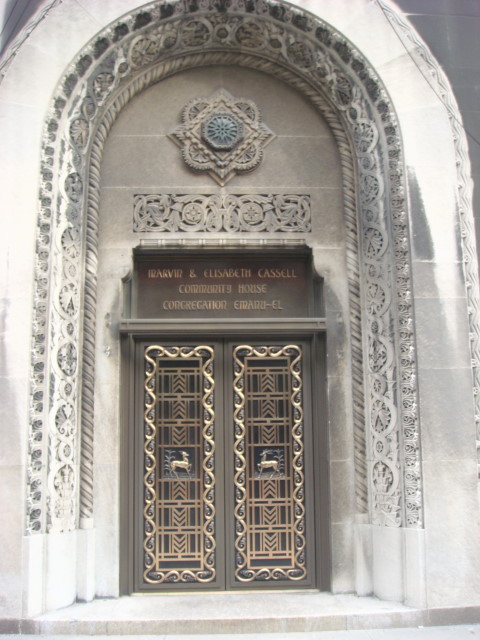
As always, I love a good doorway.

20080126-temple-emanu-el-01.jpg

Wikipedia provided other items that I wasn’t aware of.  The site was where John Jacob Astor’s old mansion used to be.  In NYC, that’s class.  It also has seating for more people than St. Patricks Cathedral.  That’s big anywhere.

Here’s another shot of the Temple that indicates where those 2,500 congregants can fit.  This is from the 65th Street side.

20080126-temple-emanu-el-02.jpg

-H

The Kosciuszko Foundation

February 7, 2008

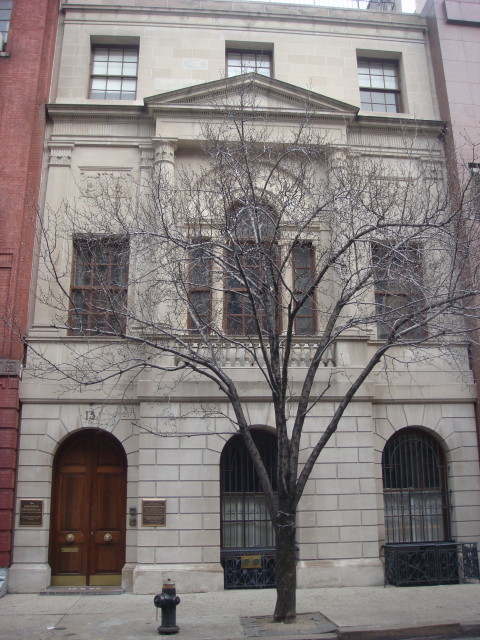
Thaddeus Kosciuszko (lots of spellings of his name as you might expect) was a Polish hero of the American Revolutionary War, and on East 65th Street there’s the site of a foundation named after him.  It’s a Polish-American group that primarily works to promote educational and artistic exchange between the US and Poland.  I’ve heard that they have a library or museum inside, but wasn’t able to find out when I went by there.

20080126-kosciuszko-foundation-01.jpg

There are two plaques next to the door.  The first gives the briefest of histories of the Revolutionary War hero.

20080126-kosciuszko-foundation-02.jpg

The fact that he oversaw the fortifications of West Point is a huge plus for the man as it was the bulwark against the British drive to break the revolution into isolated pockets.  The quote from Jefferson is about as fine a testament to a patriot as you can find.  It reads “He is as pure a son of liberty as I have ever known, and of that liberty which is to go to all, and not to the few and rich alone.”

The second plaque is simply a naming of the foundation and gives the goal of the foundation:  An American Center for Polish Culture.

I’ve actually had a “nodding acquaintance” with Koscuisko for a long, long time.  When I lived in Washington DC, I found that he was one of the five statues located in Lafayette Park.  He was the only one I wasn’t familiar with at the time and I went out of my way over the years to find out a little more about the man.

-H

Riis Houses on Ave D in Alphabet City

February 4, 2008

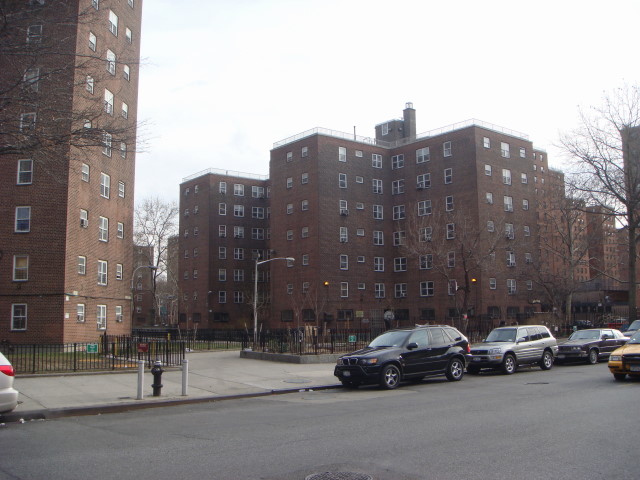
At the end of Alphabet City is the Jacob Riis Housing projects.  I was there on a very cold day and the smart people, unlike Famous Ankles, were inside and comfortable.

But, I have to admit that I’m not fond of this area.  Not because of anything other than the Soviet-style feel to the place and it’s general lack of any aesthetic that I can appreciate.

20080113-riis-houses-on-ave-d-01.jpg

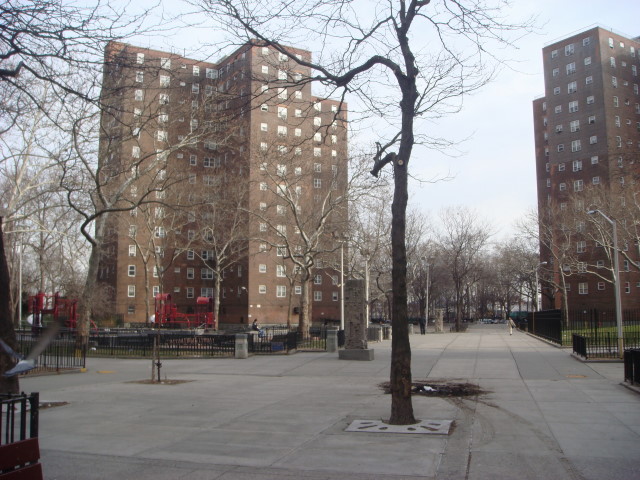
I guess that they may look good on paper and they are probably laid out in some nice little grid that I can’t appreciate…but I just don’t think much of the area.

20080113-riis-houses-on-ave-d-03.jpg

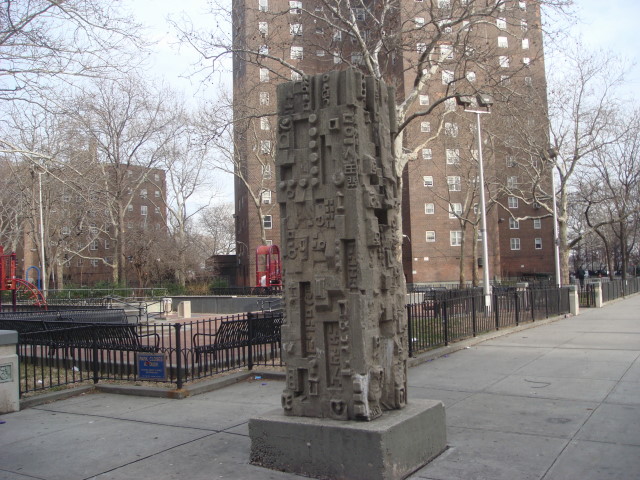
In the middle of the above picture, you can see a bit of artwork that someone put there.  And to the left, there’s a children’s playground.

Here’s a closeup of the sculpture.

20080113-riis-houses-on-ave-d-04-sculpture.jpg

And the playground.

20080113-riis-houses-on-ave-d-05-playground.jpg

I mean, there’s nothing really to object to, but I don’t like it.  Maybe it’s because it looks like a low-income project, and maybe it is one, and such things seem to have a hopelessness about them.  But, I think it is just that it is so very sterile and there’s no signs of life here.  No sign of commercial activity, no sign of much.  I’d just walked through a number of blocks of mostly empty streets, but got none of the negative feeling I got from here.  I hope and expect it’s more my imagination than anything else, but all I can think of is that some architects really didn’t put much of themselves into this place.

-H